_edited.png)
Walk Behind Water: Hiking to Grotto Falls in Great Smoky Mountains National Park

Updated: Sep 8
The hike to Grotto Falls in Great Smoky Mountains National Park is one of the most popular waterfall hikes in the Smokies, known for its unique feature as the only waterfall where hikers can walk directly behind the cascade. Following the scenic Trillium Gap Trail, this moderately easy Smoky Mountains hike passes through dense old-growth forest, towering Eastern hemlocks, and seasonal wildflowers before reaching the 25-foot falls tucked into a shaded hollow. Accessed from the narrow and often busy Roaring Fork Motor Nature Trail, the Grotto Falls hike is best known for its limited parking, early morning crowds, and rewarding forest scenery that makes it one of the top short hikes in the Smoky Mountains for visitors seeking both accessibility and natural beauty.
Trail Info
Length 2.8 miles
Elevation gain 540 feet
Route Out & back
Permit required parking tag
Dogs allowed no
Trailhead elevation 3,170'
Water Near Grotto Falls
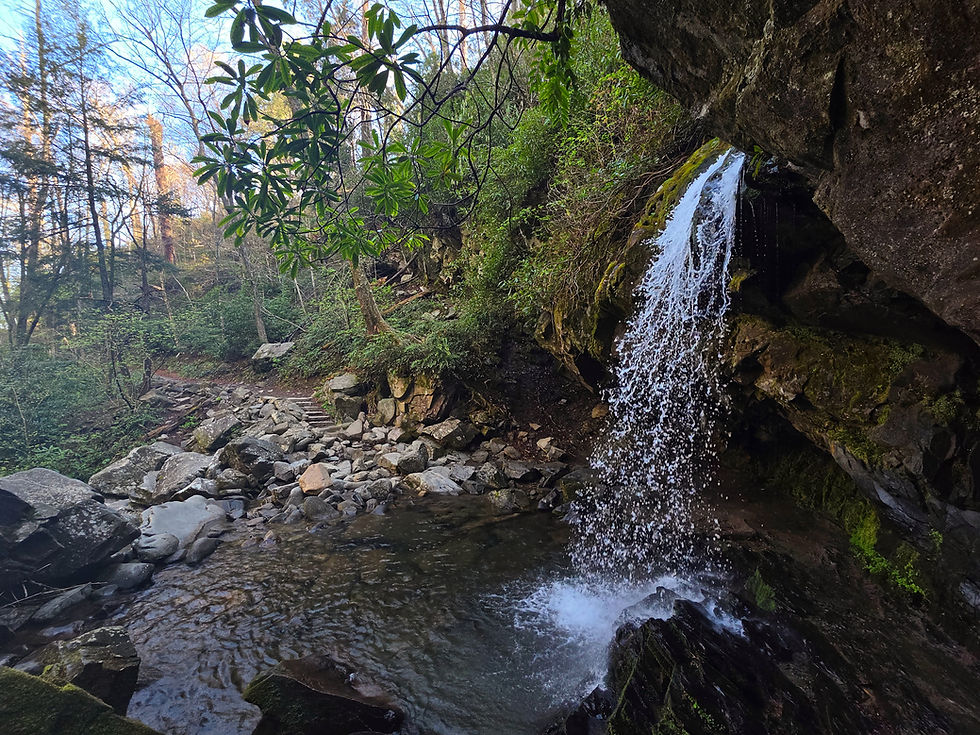
Don't miss the obvious - walking behind the falls
Hiking to Grotto Falls
The drive to the trailhead along Roaring Fork Motor Nature Trail is painfully slow. The speed limit drops to 10–15 mph, and traffic often moves even slower as drivers stop constantly for wildlife—especially the ridiculously common white-tailed deer. By the time I reach the trailhead, I’m creeping along a one-way road that feels like it takes forever. Parking is always the real challenge here. The lot only holds about a dozen vehicles, and it typically fills by around 8 AM. I manage to snag the last open spot, toss my parking tag on the dash, and finally head toward the trail.

From the trailhead, the Trillium Gap Trail climbs gently through dense, beautiful forest dominated by massive Eastern hemlocks. These trees are one of the foundational species in Great Smoky Mountains National Park, helping shade streams, stabilize soil, and support a wide range of plant and animal life. Unfortunately, many of them have been impacted over the past two decades by the invasive hemlock woolly adelgid, which has decimated large portions of the population since it was first detected around the early 2000s.

As I move along the trail, I hear a small stream off to my left before crossing it over a few large rocks. The forest here feels classic Smokies—lush, damp, and layered with rhododendron, mixed hardwoods, and scattered hemlocks.

In mid-April, the forest floor is especially striking, with trillium blooms scattered throughout the understory. The trail itself is well-maintained and steadily but gently gains elevation, with no real mountain views—just immersive forest the entire way.

About halfway in, I run into Chris. He’s local to the area now but originally from my home state, and we fall into a conversation about hiking in the Smokies and why he moved to the Pigeon Forge and Gatlinburg area. He knows the park well and starts pointing out lesser-known hikes and spots that don’t usually show up on tourist lists. At one point, he mentions the ongoing efforts to protect the hemlocks from the hemlock woolly, breaking down what the park service has been doing in a way that actually makes it easy to understand. If I’m remembering right, it’s a mix of widespread chemical treatments, biological control using predatory beetles, and long-term monitoring to slow the spread. We end up talking for a while—one of those trail conversations that just keeps going. As the trail continues, I start hearing the sound of water more consistently off to the side. Around 1.25 miles in, the path begins to parallel Roaring Fork, where small cascades appear through the trees.
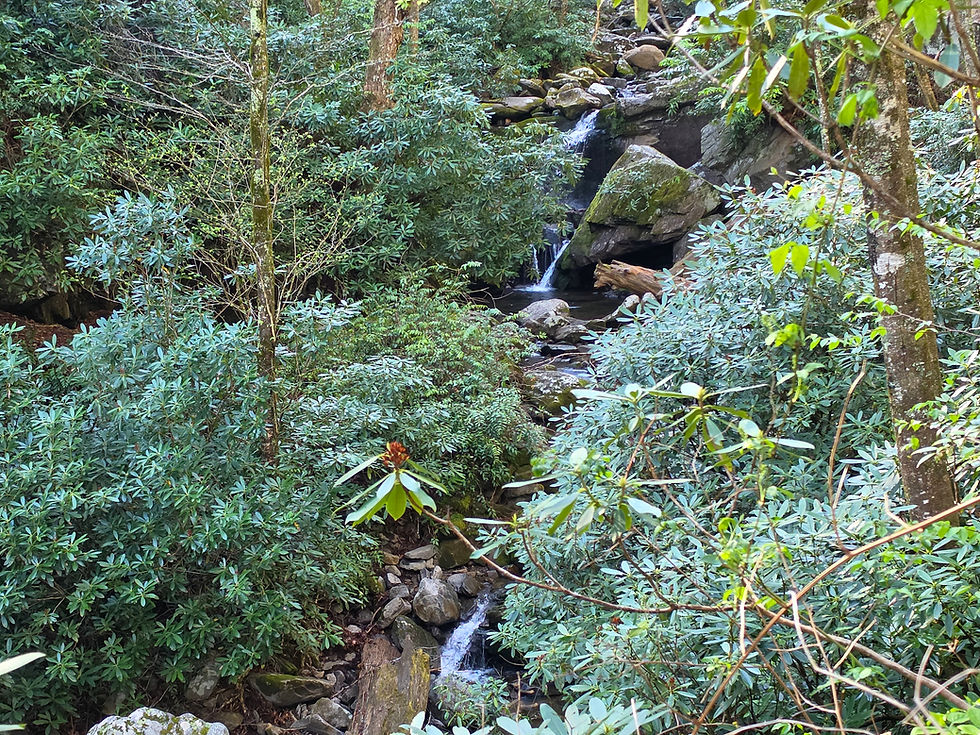
It then dips into a cool, mossy alcove, and the sound of rushing water builds before the falls suddenly come into view, making the experience feel more dramatic than you’d expect from a relatively small cascade.

Normally, there’s a steady line of hikers waiting to walk behind the falls, but today I get lucky. One of the things that makes Grotto Falls so unique is that it’s the only waterfall in Great Smoky Mountains National Park where you can actually walk behind the curtain of water. Shortly after I arrive, Chris shows up again. We pick up the conversation right where we left off, talking more about the area, life around Gatlinburg, and hiking options that most visitors overlook. He even offers to snap a photo of me behind the falls. I initially pass, but he insists enough times that I eventually give in.

We hang out at the falls for a while, chatting with a few other hikers and helping take photos for visiting families. Chris, if you ever read this, thanks for the conversation and the tips, brother!

Even though Grotto Falls isn’t the tallest waterfall in the park—that distinction goes to Ramsey Cascades—it’s easily one of the most distinctive thanks to that rare walk-behind feature.
After spending some time at the falls, I eventually head back down the Trillium Gap Trail. The return hike is just as scenic, with filtered light through the forest canopy and the steady sound of streams in the background. The drive out along Roaring Fork is equally scenic, passing historic structures, pull-offs with rushing streams, and trailheads like Baskins Creek Falls. If there’s one key takeaway from hiking Grotto Falls, it’s this: get there early. Parking is extremely limited, and overflow options are minimal. But arriving early not only solves the parking problem—it also gives you a better chance of experiencing the trail without the heavy crowds. And if you’re really lucky, you might even catch the llama train carrying supplies along the Trillium Gap Trail heading to LeConte Lodge—one of those uniquely Smoky Mountains moments you don’t forget.


Comments