
Hiking the Downy Loop: Discover Hudson's Hidden History

One of the best short hikes in Hudson, Ohio, for those who enjoy peaceful woodlands and local history is the Downy Loop Trail at Wood Hollow Metro Park. Part of the Summit Metro Parks system, the easy 1.2-mile loop winds through beautiful beech-maple forests, crosses wetlands, and passes through open meadows that were once part of the area's agricultural landscape. While the scenery is pleasant, what makes this little-known park especially interesting is its history, which includes Native American activity, 19th-century farming, and archaeological investigations conducted before the park opened to the public.

Trail Info
Length 1.2 miles
Elevation gain 25 feet
Route Loop
Permit required No
Dogs allowed On leash
Trailhead elevation 1,117'
Water none
Don't miss the old farm silo remnant
Hiking the Downy Loop
The hike begins at the parking area off Barlow Road, where the Downy Loop Trail passes by a small pond and viewing deck before heading into the surrounding woodland.


Almost immediately, hikers are surrounded by a beautiful forest dominated by American beech and sugar maple trees, two species that once covered much of northeastern Ohio. The relatively flat trail makes for an easy walk, with near zero changes in elevation as it winds through the forest.
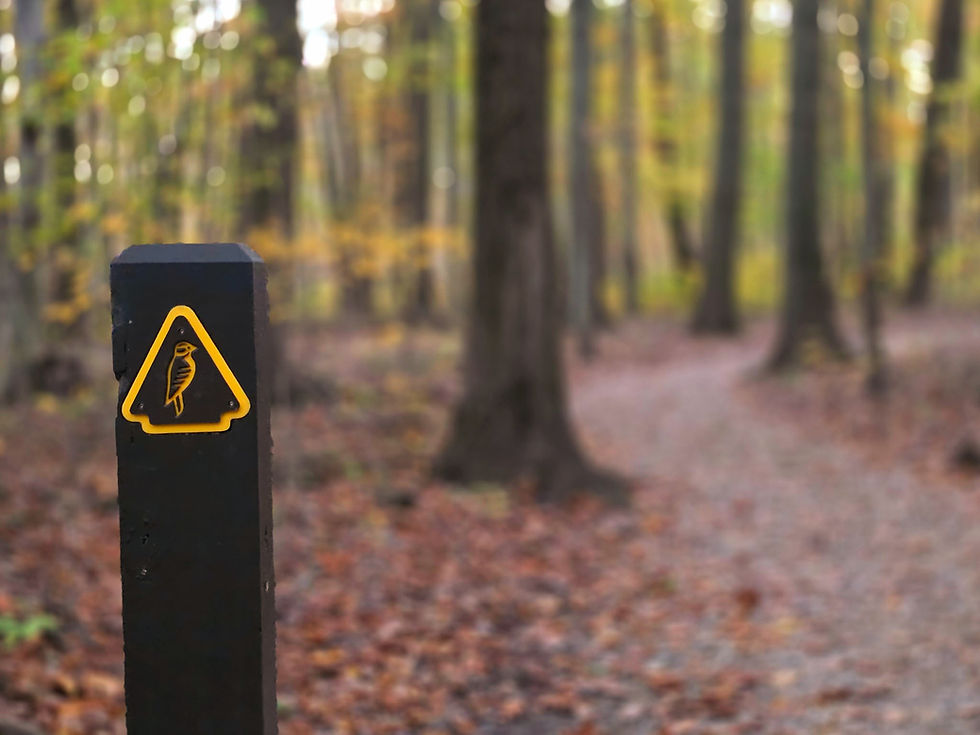
The park takes its name from the natural hollows found in trees, which provide nesting and sheltering for birds and other wildlife. The trail itself is named after the downy woodpecker, one of North America's smallest woodpeckers and a common resident of Ohio's forests.

As the trail continues deeper into the woods, it passes through low-lying areas where wetlands and seasonal pools create important habitats for amphibians, birds, and other wildlife. During the spring, these habitats become especially active as salamanders emerge from their underground shelters and migrate toward temporary pools to breed. Wood Hollow is known for its spotted salamanders, whose dark bodies and distinctive yellow spots make them one of the more recognizable amphibians in northeastern Ohio.

As you make your way through the forest, it's worth remembering that this landscape has a human history stretching back thousands of years, long before Hudson was established. In 2013, archaeologists conducted investigations at Wood Hollow to better understand the property's past, uncovering evidence of Indigenous activity. Among their discoveries were charcoal deposits and remnants of ancient hearths, which radiocarbon dating linked to both the Early Woodland Period (1000 BC to 100 BC) and the much later Whittlesey Period (1000 AD to 1650 AD). The findings suggest that Indigenous peoples occupied or used this land at different points across more than two millennia, adding a fascinating historical dimension to an otherwise quiet walk through the woods.
Today, the forest offers little indication of this much older human history, making the archaeological investigations one of the park's more intriguing stories.

By the mid-1800s, portions of present-day Wood Hollow Metro Park had been transformed into working farmland, including property owned by Reverend Chester Birge, a Presbyterian minister and educator who moved to Hudson in 1852. Born in Bolton, Connecticut, in 1796, Birge studied theology at Yale before traveling west to Ohio as a missionary. In 1830, he became pastor of the Presbyterian and Congregational churches in Vienna, Ohio, but declining health eventually forced him to leave the ministry. He subsequently turned his attention to education, helping establish the Vienna Academy, where he served as principal and earned a reputation as a strict disciplinarian. In 1852, Birge relocated his family to Hudson to provide better educational opportunities for his children, settling on land that would eventually become part of Wood Hollow Metro Park. His connection to the property is documented on an 1856 plot map, which identifies Birge as a landowner within the boundaries of what is now the park

He remained in Hudson until his death in 1861 at the age of 64 and was buried in the town's Markillie Cemetery.

During Birge's lifetime, the surrounding landscape would have looked considerably different from the forest hikers encounter today, with portions of the property consisting of open fields, pastures, and agricultural buildings. Over the generations, much of this former farmland gradually returned to forest, leaving few visible reminders of the families who once called it home.

One surviving reminder of the property's agricultural past is the foundation of an old silo, which can be spotted near the 1-mile mark, about 15 feet off the left side of the trail when hiking clockwise. Easily overlooked during the warmer months when hidden behind vegetation, the remains offer a glimpse into the land's farming history and the generations of families who lived and worked here long before Wood Hollow became a public park.

Eventually, the trail emerges from the denser woodland and passes through an open meadow, offering a change of scenery from the shaded forest. The open area provides a glimpse of the park's agricultural past while also creating valuable habitat for grassland birds, butterflies, and other wildlife. The contrast between the meadow and surrounding woods is particularly beautiful during the autumn months, when the hardwoods begin changing color and the grasses take on shades of gold and brown.

Continuing along the loop, hikers eventually cross the park's entrance drive before returning to the parking area, completing the easy walk.

Wood Hollow Metro Park owes its existence in large part to an anonymous family who donated approximately 150 acres to Summit Metro Parks in 2009. The family had enjoyed visiting the park district's properties and participating in its annual Fall Hiking Spree, and their generous donation became the foundation for a new park in Hudson. Summit Metro Parks subsequently acquired neighboring properties, expanding the protected landscape to more than 300 acres. On May 19, 2015, Wood Hollow officially opened to the public, becoming the park district's 15th developed park and its first in Hudson.

Today, the Downy Loop Trail offers far more than its modest distance might suggest. Between its mature forests, seasonal wetlands, wildlife, and remnants of Hudson's agricultural history, the trail provides a surprisingly varied experience in a relatively small area. For hikers interested in the lesser-known stories of Northeast Ohio, Wood Hollow is a great reminder that even the quietest patches of woodland can hold centuries of history.


Comments