_edited.png)
Hiking the Chapin Forest Trail: Northeast Ohio's Most Underrated Hike?

Updated: Sep 8
Hiking the Chapin Forest Trail in Chapin Forest Reservation offers one of the most underrated outdoor adventures in Northeast Ohio. Known for its peaceful woodlands, towering forests, and a particularly breathtaking overlook, the Chapin Forest Trail feels worlds away from the busy suburbs surrounding Cleveland. Whether you’re searching for one of the best hikes near Cleveland, a quiet nature escape in Lake County, or a trail filled with beautiful scenery year-round, hiking Chapin Forest Reservation delivers a fantastic outdoor experience and a bit of world history intertwined. From shaded forest paths and steep ravines to panoramic views stretching across the region, the hidden gem is a must-visit destination for hikers exploring the best hiking trails in Northeast Ohio.

Trail Info
Length 5.5 miles
Elevation gain 310 feet
Route Loop
Permit required no
Dogs allowed on leash
Trailhead elevation 995'
Water at three picnic areas along the trail
Don't miss sunset from the scenic overlook
Hiking the Chapin Forest Trail
Chapin Forest Reservation features several hiking trails, but to fully experience one of the best hikes in Northeast Ohio, hikers can combine sections of the Arbor Lane, Beech Woods, Turkey, Lucky Stone, Quarry, and Whispering Pines Trails into a scenic 5.5-mile loop that showcases the park’s top highlights. A large parking area near the Twin Ponds Shelter serves as the ideal starting point for hiking Chapin Forest Reservation. Hiking the loop counterclockwise is recommended, as it allows the elevation gain to come more gradually, making for a more enjoyable experience.

From the trailhead, the path quickly enters a mature hardwood forest filled with towering beech, maple, oak, and tulip trees that create a dense canopy, especially stunning during fall color in Northeast Ohio. At one time, forests like this covered much of Ohio before widespread logging and agriculture transformed the landscape. Today, thanks to Frederic H. Chapin—a conservation-minded philanthropist who purchased the land in 1949 and later donated it to the State of Ohio—the forest remains remarkably well preserved through a partnership with the Ohio Department of Natural Resources.

The trail winds through peaceful woodlands before arriving at the Chapin Ledges, one of the reservation’s most fascinating natural features. Formed roughly 300 million years ago, these rocky outcroppings are made of Sharon Conglomerate, predating the glaciers that later sculpted northern Ohio. Exploring the ledges is often a highlight of hiking Chapin Forest Reservation, though families with small children should use caution, as several areas feature steep drop-offs.

While not as dramatic as the towering formations along the Ledges Trail in Cuyahoga Valley National Park or as historically intriguing as the carved sandstone at Worden’s Ledges in nearby Hinckley, the Chapin Ledges are still well worth a short off-trail detour, even if only to admire them from above.

Beyond the ledges, the trail descends steeply to their base before continuing past Ledges Shelter, where hikers will find restrooms. Soon after, the route crosses a small footbridge spanning a stream where wildlife sightings are common, including black rat snakes, white-tailed deer, and owls hidden among the forest canopy.

The incredibly well-maintained trail meanders through dense forest, occasionally opening to patches of sunlight as it gradually heads north. Around the 2-mile mark, hikers pass Forest Shelter, and roughly a quarter mile later reach Quarry Shelter, restrooms, and scenic Quarry Pond.

As the trail circles the pond, hikers encounter remnants of the historic Stannard Quarry, an 1800s sandstone quarry owned and operated by Claudius Stannard, one of Kirtland’s earliest landowners.

Stannard had a surprisingly important—though somewhat complicated—connection to the early Mormon movement in Kirtland. Most notably, his quarry supplied sandstone used to construct the Kirtland Temple, the first temple built by members of the Church of Jesus Christ of Latter-day Saints under Joseph Smith in the 1830s. Located roughly two miles south of the temple in what is now Chapin Forest Reservation, the quarry provided locally sourced sandstone blocks for construction, and traces of the quarry’s operation can still be seen right along the trail today.

What makes Claudius Stannard particularly fascinating is that he does not appear to have been Mormon himself, yet he maintained extensive financial and business relationships with early church leaders. In October 1836, Stannard entered into a major land agreement involving nearly 200 acres in Kirtland with prominent Mormon leaders including Joseph Smith Jr., Brigham Young, and Parley P. Pratt. The transaction later became the subject of legal disputes as the church’s financial troubles escalated in the late 1830s. From roughly 1831 to 1838, Kirtland served as headquarters for the Mormon movement, and by the mid-1830s, nearly half the town’s population had ties to the church. They were effectively driven out of Kirtland in 1838, though the decline of the Mormon presence began in 1837 after financial collapse, internal dissent, and escalating tensions with non-Mormon residents. After leaving Kirtland, many members of the Mormon movement relocated to Missouri in search of a fresh start. Ironically, the persecution they faced there proved even more severe. Rising tensions with local residents ultimately culminated in Missouri’s infamous Mormon Extermination Order of 1838, forcing the Latter-day Saints to flee the state once again. Despite their departure, Kirtland remains one of the most significant places in Mormon history outside of Utah. Today, Historic Kirtland preserves the temple, homes, stores, and other sites connected to Joseph Smith and the early church, making the area a major pilgrimage destination for Latter-day Saints from around the world.

After circling Quarry Pond and viewing the quarry's remnants, hikers retrace their steps toward the ledges area before ascending Gildersleeve Mountain, one of the highest points in Lake County. Around the 4-mile mark, the trail reaches one of Chapin Forest Reservation’s signature features: a northwest-facing scenic overlook offering sweeping views across Lake County and toward Lake Erie on clear days.
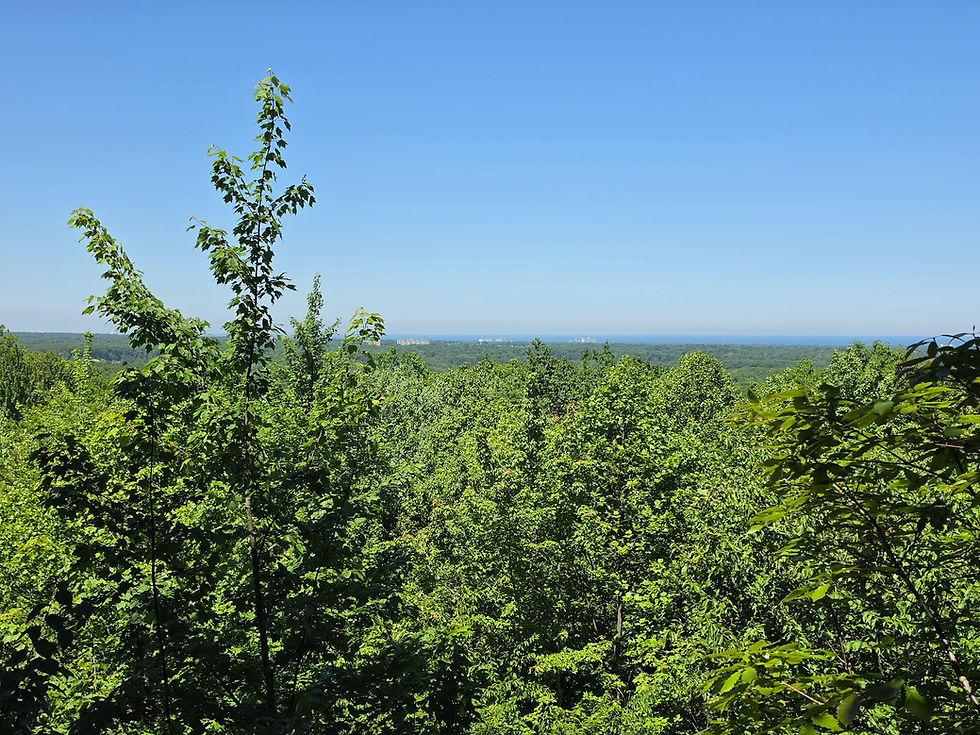
For those hiking later in the day, the overlook provides one of the best sunset views in Northeast Ohio.
Beyond the overlook, the trail gradually descends through the forest, eventually crossing a modest footbridge and returning to the trailhead along the Whispering Pines Trail.

Whether you come for the scenic overlook, fascinating history, or a peaceful forest setting, hiking the Chapin Forest Trail offers one of the most rewarding outdoor experiences in Northeast Ohio. With towering hardwood forests, ancient ledges, panoramic views, and connections to Kirtland’s rich past, this hidden gem is a hike that deserves a spot on every local adventurer’s bucket list.


Comments