_edited.png)
Grinding Through History: The Gorge Loop & Lanterman's Mill

Few hikes in Northeast Ohio combine scenery and history quite like the Gorge Loop at Lanterman’s Mill in Youngstown’s Mill Creek Park. The trail winds through a surprisingly rugged sandstone gorge along Mill Creek, passing towering rock walls, historic landmarks and the picturesque Lanterman’s Falls. Along the way, hikers encounter more than two centuries of local history, from an 1800s gristmill and a Victorian-era suspension bridge to forgotten mineral springs and even tales of Prohibition and organized crime. It’s a short hike that packs an incredible amount of scenery and history into one of the most unique corners of Northeast Ohio.

Trail Info
Length 2.2 miles
Elevation gain 120 feet
Route Loop
Permit required No
Dogs allowed On leash
Trailhead elevation 982'
Water None filterable
Don't miss the self-guided tour of Lanterman's Mill
Hiking the Gorge Loop
The hike begins from a modest parking lot off East Park Drive beside Lanterman’s Falls Bridge, with room for roughly 20 vehicles. The lot tends to fill early on busy weekends, but overflow parking can be found about a hundred yards beyond the main lot.

After crossing Canfield Road, hikers descend a short wooden staircase and immediately arrive at one of the most recognizable landmarks in Youngstown: Lanterman’s Mill. Perched along the rocky banks of Mill Creek beside the cascading waters of Lanterman’s Falls, the historic mill makes for a dramatic beginning to the hike.

But long before it became one of the most photographed places in Mill Creek Park, the waterfall was recognized for something far more practical: power.

In 1797, surveyors Isaac Powers and Phineas Hill were exploring the still-unnamed Mill Creek for John Young, the founder of Youngstown, when they came across the natural falls. Hill wanted the surrounding 300 acres, but Young reportedly attached an interesting condition to the sale—Hill had to build a sawmill and gristmill at the falls within 18 months. The resulting mill began operating around 1799, making the site an industrial center decades before Youngstown became synonymous with steel.

That original log mill lasted until 1822 and was replaced the following year by a second gristmill built by Eli Baldwin. Nature eventually had other plans. A powerful flood swept Baldwin’s mill away in 1843, but it left behind one remarkable piece of evidence: one of its grinding stones was carried roughly 500 feet downstream, where the stone can still be seen in the creek bed today. It is an easy detail to overlook while hiking through the gorge, but that lonely millstone is a physical remnant of an earlier mill that disappeared more than 180 years ago.

The mill standing beside the waterfall today was constructed in 1845–46 by German Lanterman and his brother-in-law, Samuel Kimberly. Apparently learning a lesson from the fate of its predecessor, the builders didn't take any chances—the walls at the base of the mill are reportedly about ten feet thick.

The new operation became a successful gristmill equipped with three sets of grinding stones, using the power of Mill Creek to turn grain from surrounding farms into flour and meal. The mill continued operating until 1888, when the rise of newer, more efficient roller mills appears to have made old-fashioned water-powered operations like Lanterman’s increasingly difficult to compete with.

Ironically, the end of Lanterman’s Mill as an industrial operation may have helped save it. Youngstown attorney Volney Rogers was then working to preserve the spectacular Mill Creek Gorge from development. Mill Creek Park was established in 1891, and the deteriorating mill was acquired by the park the following year. Had that not happened, the building could easily have disappeared like countless other 19th-century mills. Instead, it began a second life that was considerably more colorful than simply grinding grain.

For a time, Lanterman’s Mill became something of an entertainment center. The old industrial building contained a ballroom, concession stand and bathhouse, while the water below the falls—known as the Pool of Shadows—became a popular swimming hole. The upper floors were even used to store boats during the winter. It's difficult to picture today, but generations ago this quiet corner of the gorge was a summertime gathering place where Youngstown residents came to swim, socialize, dance and spend the day beside the falls.
And this is where the history of Lanterman’s Mill becomes considerably murkier—and perhaps more intriguing.

One persistent piece of Youngstown lore claims that an illegal gambling hall operated on the second floor of Lanterman’s Mill during the 1930s and had connections to organized crime. One online account passed down through a local family describes a grandfather who supposedly visited the gambling room as a young man, even recalling bringing dates there. Another resident claimed knowledge of the same operation through family connections to organized crime.

What makes the story especially tantalizing is that illegal gambling and organized crime in Youngstown during this period are very well documented. Lottery houses flourished around the city during the mid-to-late 1930s, and illegal gambling eventually became one of the Mahoning Valley underworld's most lucrative businesses.

Youngstown sat between the spheres of influence of organized-crime factions associated with Cleveland and Pittsburgh, and disputes over gambling territory later contributed to the violence that gave the city its notorious "Crimetown U.S.A." reputation. Gambling raids in the Mahoning Valley can be traced through newspaper archives from the 1930s onward, and by the 1940s the infamous Jungle Inn in nearby Liberty Township had become one of the region's best-known illegal gambling establishments. In other words, the alleged gambling room at Lanterman’s Mill fits the world Youngstown was living in at the time—even though that does not prove the story itself.
There is another curious story attached to the mill. According to Lanterman’s Mill manager Eric Simione, there has long been a rumor that the building was used as an illegal distillery during Prohibition. Simione has said that he has been unable to find evidence proving the story. Still, its persistence adds another layer of mystery to a building that spent decades being used for purposes far removed from grinding grain.

The documented timeline is interesting in its own right: swimming around the mill ended shortly before national Prohibition began, while the mill became a nature museum in 1933—the same year Prohibition ended. There is no proof that anything illicit happened between those events, but the gap has provided plenty of room for local stories to grow.

The darker reputation surrounding Mill Creek Park isn't entirely folklore, either. One particularly haunting chapter occurred in February 1935, when 13-year-old Frankie Suhovecky was murdered and his body was found in Mill Creek Park near Lake Cohasset. The crime was never solved. There is no evidence connecting his death to Lanterman’s Mill or organized crime, but the case offers a grim glimpse into Youngstown during the same era in which the alleged gambling operation at the mill supposedly existed.

By then, however, the documented story inside Lanterman’s Mill was much more innocent. In 1933, its first floor was converted into a nature museum filled with mounted birds, mammals and other specimens. Generations of Youngstown-area schoolchildren toured the displays, and the building eventually became the park's historical museum. Lanterman’s Mill was placed on the National Register of Historic Places in the 1970s, preserving its status as one of the Mahoning Valley's most important surviving links to the region's pre-steel industrial past.

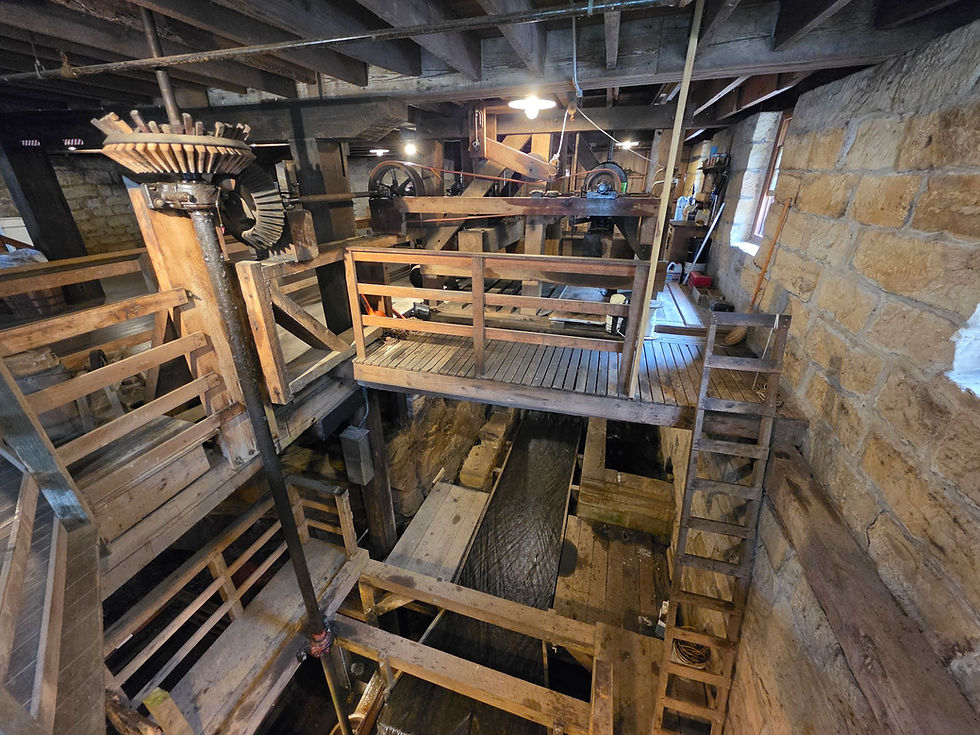
The mill's greatest transformation began in 1982. Restorers wanted to return Lanterman’s Mill to a functioning 19th-century gristmill, but there was a major problem: no original blueprints showing exactly how the machinery had worked could be found. Youngstown State University anthropology professor Dr. John White organized an archaeological excavation around the building, and the dig uncovered artifacts along with the location of an original raceway, providing evidence that an earlier water wheel had once powered the mill. With approximately $600,000 provided for the restoration through the Ward and Florence Beecher Foundations, the building underwent an extensive reconstruction before reopening in 1985.
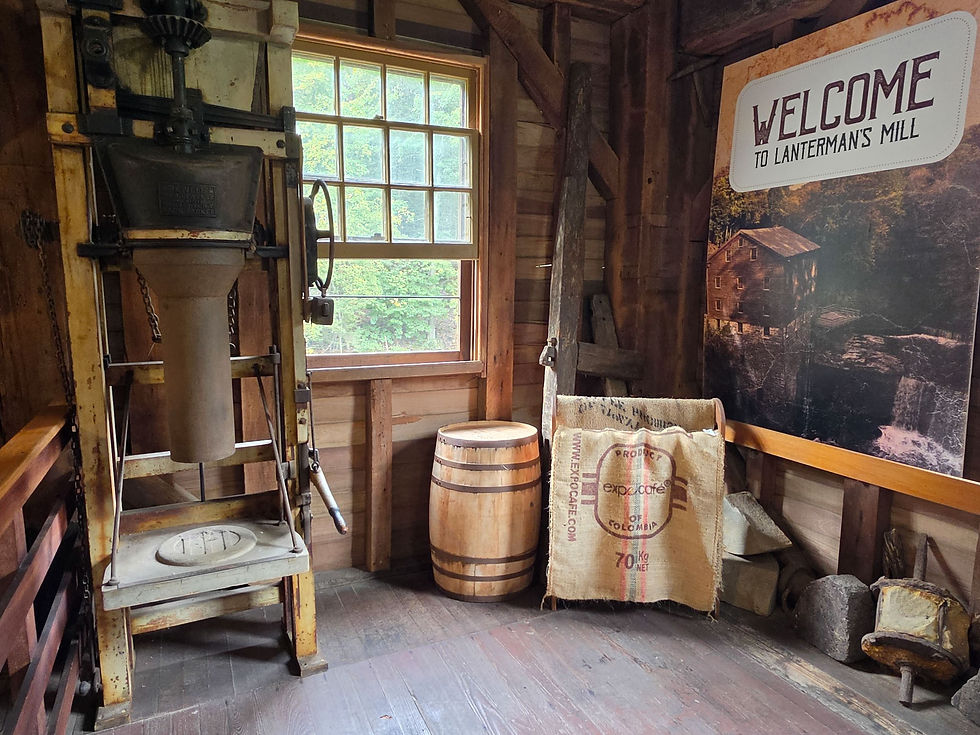
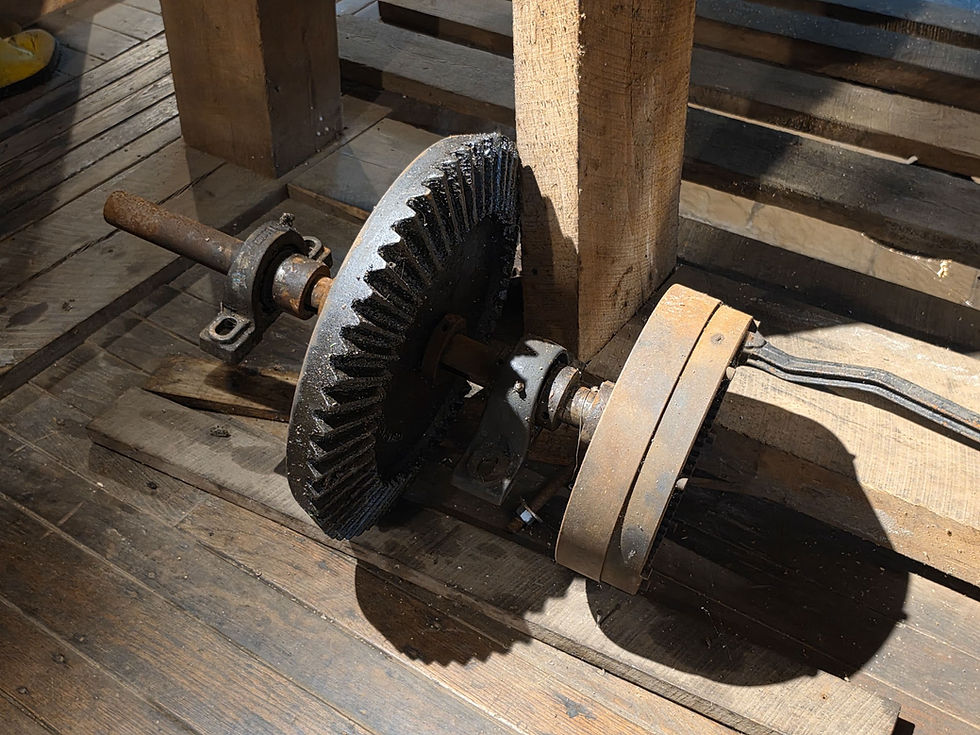
Today, Lanterman’s Mill has essentially come full circle. Water from Mill Creek once again powers a large wooden wheel connected to gears, belts and massive millstones, allowing the building to grind corn and wheat much as mills along the creek did during the 19th century. That makes Lanterman’s much more than a picturesque old building beside a waterfall—it is a functioning piece of Youngstown history. Perhaps that's what makes Lanterman’s Mill so fascinating.

Within one building are traces of nearly every chapter of Youngstown's story: pioneer settlement, early industry, recreation, preservation, Depression-era history, and the city's famously colorful underworld lore. Farmers once brought grain here to be ground. Families later came to swim beneath the falls and dance inside the old mill. Generations of children wandered through its nature museum. And somewhere along the way came whispers of Prohibition liquor and a secret upstairs gambling room supposedly connected to the mob. Some of those stories can be proven and others remain tantalizing pieces of Youngstown folklore—but together they make Lanterman’s Mill far more interesting than the postcard view from across the waterfall might suggest.

From the mill, the hike leaves much of that history behind and heads directly into one of the most scenic stretches of Mill Creek Park. The Gorge Trail follows Mill Creek downstream through a surprisingly rugged landscape of towering sandstone cliffs, enormous boulders, rock overhangs and a dense canopy of hemlocks and hardwoods. Despite being surrounded by Youngstown, there are stretches where the steep walls of the gorge and rushing water below make the city feel much farther away.

Much of the trail stays close to Mill Creek, occasionally climbing above the water before dropping back toward the creek. Wooden staircases and rocky sections add a little adventure to an otherwise manageable hike, while openings in the trees provide views into the narrow gorge below.

One of the more unexpected pieces of history along the Gorge Trail can be found on the east side of the creek, where hikers may notice a semicircle of old sandstone tucked beside the trail. From the early 1900s into the 1970s, this was the site of a sulphur spring, where visitors once stopped to drink the mineral-rich water in the belief that it offered medicinal and healing benefits. Today, the spring is largely forgotten, but the remaining sandstone provides a subtle reminder of a time when a walk through Mill Creek Park might have included a stop for a drink of supposedly therapeutic spring water.

One of the most interesting features along the way is the massive sandstone that forms the walls of the gorge. Over thousands of years, Mill Creek carved its way through the rock, leaving behind cliffs, narrow passageways and huge blocks of sandstone scattered across the forest floor. Moss and ferns cover many of the shaded rocks, giving portions of the gorge a surprisingly wild feel for a trail running through the heart of an urban park.

Around the halfway point, the trail reaches one of the hike's most impressive manmade landmarks: the Mill Creek Park Suspension Bridge. Built in 1895 by the Youngstown Bridge Company and designed by its chief engineer, Charles E. Fowler, the 86-foot-long bridge carries Valley Drive across Mill Creek and is the oldest surviving bridge in the park. Its elaborate latticework, graceful arches and castle-like spires were inspired by park founder Volney Rogers' desire to create fanciful entrances into Mill Creek Park. Over the years, its storybook appearance has earned it several nicknames, including the Silver Bridge, Cinderella Bridge, Castle Bridge and Fairy Tale Bridge. The bridge was added to the National Register of Historic Places in 1976 and underwent an extensive $523,000 rehabilitation in 2007 that restored much of its historic appearance. Even more than a century after it was built, it remains one of Mill Creek Park's most recognizable and photographed landmarks.

Eventually, the Gorge Trail reaches the historic Covered Bridge, another of Mill Creek Park's most recognizable landmarks. From here, hikers can cross Mill Creek and follow the East Gorge Trail back toward Lanterman’s Mill, turning the hike into a loop. The return trip offers a different perspective of the gorge from the opposite side of the creek, with more views of the sandstone walls, forest and water below.

As the loop approaches its end, the sound of rushing water begins to grow louder until Lanterman’s Falls and the mill reappear through the trees. It's a fitting finish to a hike where the landscape and history are almost impossible to separate. The same creek that carved the gorge beneath your feet is the creek that powered mills here more than two centuries ago—and ultimately helped shape one of the most historic corners of Youngstown.


Comments