_edited.png)
Hiking the Prairie Loop at Springfield Bog: Ancient History, Archaeological Discoveries & a Restored Prairie

Tucked away in the southeastern corner of Summit County, Springfield Bog Metro Park offers one of the most unique hiking experiences in the Akron area. The park's 1.6-mile Prairie Trail winds through expansive grasslands, colorful wildflower meadows, and ancient wetlands shaped by retreating glaciers thousands of years ago. Beyond its natural beauty, this hidden gem in the Summit Metro Parks system has a fascinating history involving prehistoric Native American inhabitants, generations of farmers, and a once-popular berry-picking destination. Today, hikers can explore a landscape that has been transformed from agricultural fields into a thriving prairie ecosystem.

Trail Info
Length 2 miles
Elevation gain 30 feet
Route Loop
Permit required No
Dogs allowed On leash
Trailhead elevation 1,155'
Water none
Don't miss sunrise or sunset
Hiking the Springfield Bog Prairie Loop
The hike begins at the Prairie Trailhead along Portage Line Road, where visitors will find a parking area, restrooms, and picnic tables. Unlike the heavily forested trails and steep ravines found throughout much of Summit County, the Prairie Trail follows gently rolling terrain through wide-open grasslands. The easy loop offers expansive views of the surrounding landscape, with very little elevation change, making it an excellent choice for hikers of nearly all experience levels.

One of the most interesting aspects of Springfield Bog is that the landscape holds evidence of human activity dating back thousands of years. Archaeological investigations have identified a prehistoric site within the park dating to approximately 7000-500 B.C., placing human activity here during Ohio's Archaic period through the beginning of the Early Woodland period. Prehistoric stone artifacts recovered from the area provide tangible evidence that Indigenous peoples were using this landscape long before European settlers arrived.

The University of Akron's Community Archaeology Program has documented the area's archaeological significance, including a collection of stone artifacts known as the Springfield Lithic Collection. These discoveries offer a glimpse into the lives of early inhabitants who depended on the region's abundant natural resources. The bogs and surrounding wetlands would have attracted wildlife, including waterfowl and other animals, while providing access to edible plants, freshwater, and materials useful for everyday survival.

The wetlands themselves have an equally fascinating history, one that stretches back to the end of the last Ice Age. As massive glaciers retreated from Northeast Ohio, they left behind depressions in the landscape, some formed when enormous blocks of buried ice slowly melted. These depressions eventually filled with water, creating kettle lakes and wetlands. Over thousands of years, accumulated vegetation helped transform some of these areas into the bogs that remain today.

As the Prairie Trail winds through the grasslands, hikers encounter another remarkable geographical feature: the Continental Divide. While the term often brings to mind the towering Rocky Mountains, a major drainage divide passes directly through Springfield Bog Metro Park. Rainwater falling on one side eventually travels north through the Cuyahoga River watershed toward Lake Erie, while water on the opposite side flows south through the Tuscarawas and Ohio River systems, ultimately reaching the Gulf of Mexico. It's fascinating to think that rain falling only a short distance apart can eventually end up in entirely different bodies of water.

Long after prehistoric peoples inhabited the region, much of the property became a working farm owned by generations of the Young family. The family's roots in the area stretch back to Frederick Young in the early 1800s. For more than a century, the Youngs raised dairy cattle and cultivated crops such as corn, wheat, oats, and hay. Farming eventually shifted toward soybeans during the early 1990s, a practice that continued until the property was acquired for preservation.

Perhaps the most surprising chapter in the farm's history involves the bog itself. During the late 19th and early 20th centuries, Young's Bog became a popular destination for people looking to pick wild huckleberries. Visitors traveled from Akron, Canton, and surrounding communities aboard the Akron-Canton Interurban Railway, and a railroad spur was constructed to serve the Young farm.
What is now a peaceful wetland was once a lively seasonal destination where city residents escaped into the countryside to gather berries. Commercial berry picking continued until the 1950s, leaving behind an unusual piece of local history that few modern visitors probably realize.

The property was also home to two historic farmsteads, with agricultural activity documented as far back as the 1860s. The old farm buildings were eventually demolished because of their deteriorating condition and safety concerns, however, historical documentation describes two 45-foot-tall silos constructed from concrete blocks with brick bases, reminders of the dairy operations that once occupied the land.

Despite its long agricultural history, Springfield Bog nearly disappeared beneath suburban development. In the late 2000s, plans for residential construction threatened the former farmland and its environmentally sensitive wetlands. Recognizing the importance of preserving the property, Summit Metro Parks partnered with the Trust for Public Land and other local organizations to protect the landscape. The park officially opened to visitors in 2011, beginning a new chapter in its remarkable history.

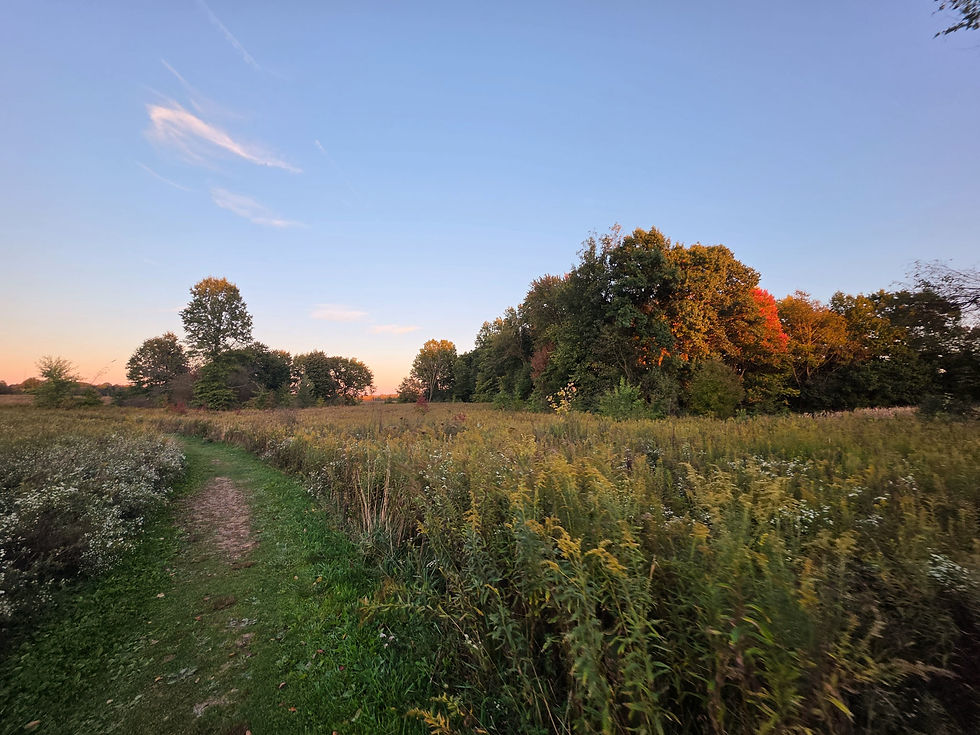
Rather than simply allowing the abandoned agricultural fields to grow wild, conservationists undertook an extensive restoration project designed to recreate the native prairie ecosystem that once existed in this part of Ohio. Historical surveys indicated that prairie habitats had historically occurred near the area's bogs and drainage divide. Native grasses, wildflowers, and other vegetation were introduced, gradually transforming former cropland into the sweeping grasslands that hikers enjoy today.
The results are particularly impressive during late summer and early autumn, when the Prairie Trail becomes surrounded by goldenrod, asters, wild sunflowers, and tall native grasses. Butterflies and bees move among the flowers, while grassland birds find valuable nesting and feeding habitat in an environment that has become increasingly uncommon throughout Ohio. With much of the trail exposed to the open sky, early morning and evening hikes can be especially beautiful as the low sunlight illuminates the prairie.

Two observation platforms along the trail offer opportunities to appreciate the park's wetlands. One overlooks Young's Bog, the naturally occurring wetland associated with the family's historic berry-picking operation. The other provides a view of the smaller, constructed wetland affectionately known as the "baby bog." These overlooks offer a quieter experience away from the surrounding grasslands, where hikers can watch for birds, frogs, and other wildlife that depend on these sensitive habitats.


What makes Springfield Bog Metro Park particularly special is how much history is contained within a relatively small landscape. Over thousands of years, the property has served as a resource for prehistoric Indigenous peoples, a working family farm, a popular berry-picking destination, and finally a protected natural area. Its transformation into a thriving prairie demonstrates how conservation efforts can restore important habitats while preserving a landscape's historical significance.

For those looking for an easy, peaceful hike with beautiful scenery and a surprisingly rich history, the Prairie Trail is well worth exploring. While it may lack the dramatic waterfalls and sandstone ledges found elsewhere in Northeast Ohio, Springfield Bog offers something equally fascinating: an opportunity to walk through a landscape shaped by glaciers, inhabited by people thousands of years ago, and brought back to life through one of Summit County's most impressive prairie restoration efforts.


Comments