_edited.png)
Rock Creek & Old Mill Loop: A Peaceful Walk in Furnace Run
Tucked into the wooded hills of Furnace Run Metro Park, the Rock Creek & Old Mill Loop combines a peaceful Northeast Ohio hike with more than two centuries of local history. The trail winds beneath a mature hardwood canopy, follows scenic Rock Creek, and explores land once surrounded by some of Richfield’s earliest water-powered sawmills. Along the way, hikers can discover the story of the Brush family, whose land helped establish Furnace Run Metro Park in 1929. With beautiful forests, creekside scenery, and intriguing history, the Rock Creek & Old Mill Loop is one of the more underrated hiking trails in the greater Akron area.

Trail Info
Length 2.8 miles
Elevation gain 75 feet
Route Loop
Permit required No
Dogs allowed On leash
Trailhead elevation 1,020'
Water fountain at the pavilion
Don't miss Relaxing along Brushwood Lake
Hiking the Rock Creek & Old Mill Loop
The hike begins within the Brushwood Area of Richfield’s Furnace Run Metro Park, where visitors will find a large parking area, restrooms, a pavilion, and Brushwood Lake.

From the trailhead, a short walk along a paved path crosses Rock Creek and passes a beautiful picnic area before entering the woods.

The Rock Creek & Old Mill Loop isn’t known for sweeping views, waterfalls, or dramatic overlooks. Instead, it’s a peaceful walk through the woods, with occasional views of Rock Creek beneath a mature canopy of oak, sugar maple, and American beech. And in many ways, it’s also a walk through history.

Long before these woods became a Metro Park, the streams flowing through them helped power some of Richfield’s earliest industry. When settlers began arriving in the early 1800s, the surrounding landscape was covered by dense forest, making lumber essential for building homes, barns, fences, and the growing community. Furnace Run provided something equally valuable: a dependable source of waterpower.

In 1818, John Farnam built Richfield Township’s first documented sawmill along Furnace Run, roughly a mile north of the center of Richfield. Farnam later moved his operation farther downstream, and he was far from the only miller to recognize the potential of the creek. Historical accounts indicate that at least seven sawmills operated along Furnace Run at various times, turning the surrounding forests into lumber as Richfield developed. By 1850, three sawmills were still operating within the township.

The land surrounding today’s Rock Creek & Old Mill Loop later became part of a sprawling property owned by Everett Farnham, who allowed local residents to use portions of his land for hiking and recreation. The property was eventually acquired by the family of Charles F. Brush, the Cleveland inventor whose arc-lighting system helped make electric street lighting commercially practical. The Brush family continued allowing people to enjoy the property, meaning the woods were being explored recreationally long before they officially became a public park.

Following the death of Charles Francis Brush Jr. in 1927, his wife, Dorothy Hamilton Brush, considered preserving part of the estate for public use. According to Summit Metro Parks, she first wanted to know whether visitors could be trusted to respect the property. After opening the land and seeing that it was generally treated responsibly, she donated roughly 272 acres in 1929 in her husband’s memory, helping establish Furnace Run Metro Park.

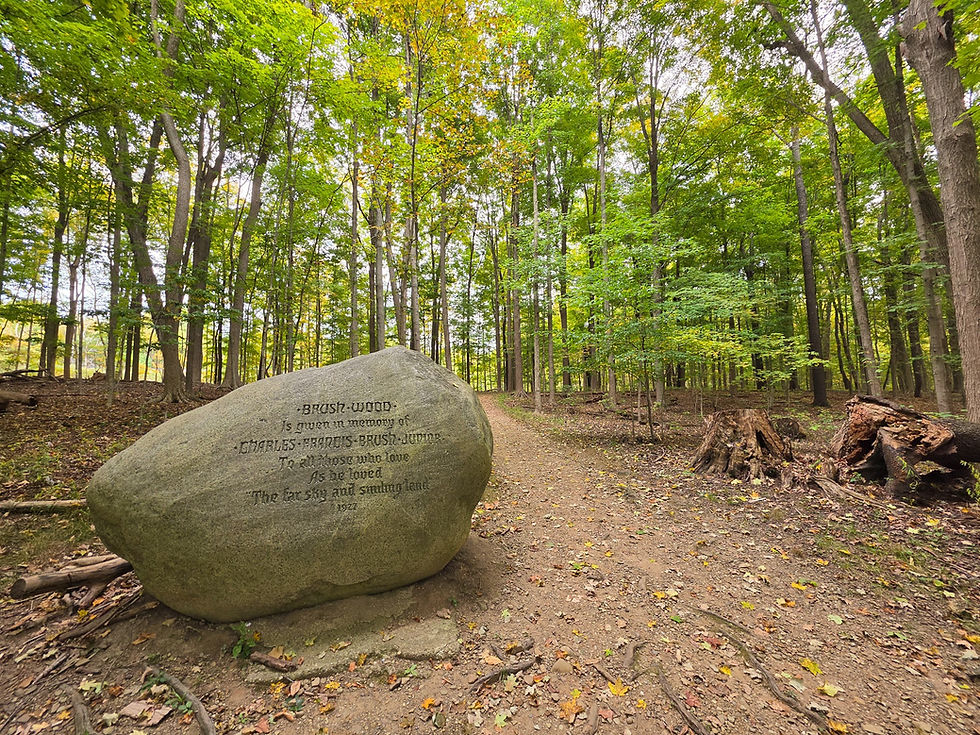
Today, hikers along the Old Mill Trail pass a large stone memorial dedicated to Charles Francis Brush Jr., providing a tangible connection to the family responsible for preserving the land.
The park changed considerably during the Great Depression, when work-relief crews helped develop Furnace Run for public recreation. Brushwood Lake, which hikers see near the beginning and end of the loop today, was created by altering the natural flow of Furnace Run and eventually became a popular swimming and picnic destination during the 1940s and 1950s. The lake also holds an important place in local social history, as it was among the limited public recreation areas in Summit County where African Americans were permitted to recreate during the era of segregation. Swimming eventually ended in 1956 as erosion and sedimentation degraded the lake.

Over the decades, Furnace Run Metro Park expanded to roughly 890 acres, preserving much of the wooded landscape surrounding Furnace Run and its tributaries. Today, the Rock Creek & Old Mill Loop provides one of the best ways to explore this historic section of the park.
The Old Mill Trail winds through mature forest and passes the Brush memorial, while the Rock Creek Trail follows its namesake stream through the wooded valley.

The Old Mill name is particularly fitting considering the numerous water-powered sawmills that once operated along Furnace Run, although surviving documentation does not clearly identify which historic mill inspired the modern trail’s name or whether one stood directly beside its present route. Even so, the Rock Creek & Old Mill Loop offers more than a quiet walk through the woods—it follows a landscape shaped by early sawmills, the Brush family estate, Depression-era park development, and nearly a century of public recreation.


Comments