_edited.png)
What's Hidden in These Woods? Hiking the Historic Camp Hilaka Loop

Hiking through Richfield Heritage Preserve is unlike almost any other trail experience in Northeast Ohio. Spread across 336 acres in Richfield, the preserve combines wooded ravines, streams and two lakes with the remnants of a former Girl Scout camp and an even older country estate. Today’s trails pass historic homes, old camp buildings and some wonderfully unusual structures, making a hike through the former Camp Crowell Hilaka feel as much like an exploration of the past as a walk through the woods.
Trail Info
Length 2.7 miles
Elevation gain 200 feet
Route Loop
Permit required No
Dogs allowed On leash
Trailhead elevation 1,198'
Water spigot near the lodge by parking lot
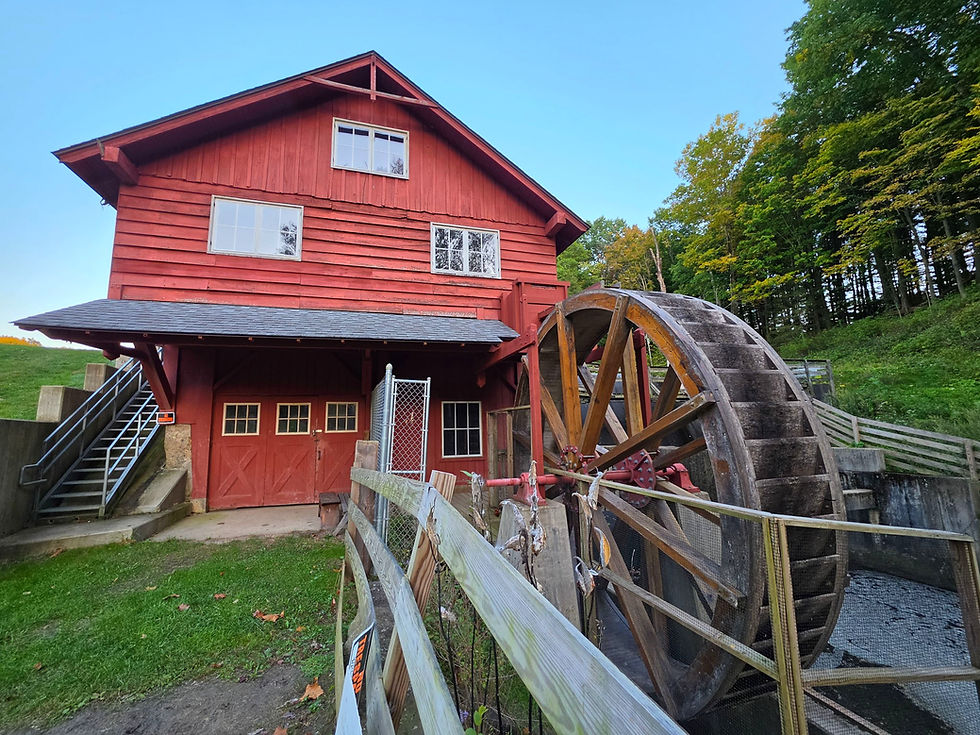
Don't miss Kirby's Mill
Hiking the Camp Hilaka Loop
The story begins in the southern portion of the preserve, an area once known as Camp Julia Crowell. Long before Girl Scouts arrived, much of this land belonged to the Oviatt family, among Richfield’s early settlers. Heman Oviatt acquired land here in 1811, and generations of the family farmed portions of the surrounding countryside. The Oviatt presence survives today in the historic Oviatt House, built in 1836.

The property changed dramatically after inventor and businessman James B. Kirby purchased the Oviatt farm in 1919 and began assembling neighboring properties into a country estate. Kirby, whose business interests included vacuum cleaners, wasn't content simply to build a house in the countryside. He reshaped the landscape, constructed lakes and created a surprisingly elaborate private retreat filled with engineering projects.
One of his most impressive projects was Kirby's Mill, constructed in 1922. Water from the estate was harnessed to operate the mill and generate electricity. The surrounding landscape had an even older milling connection: when Kirby developed his hydroelectric system, evidence of an Oviatt sawmill dating to the 1830s was reportedly discovered in the area.
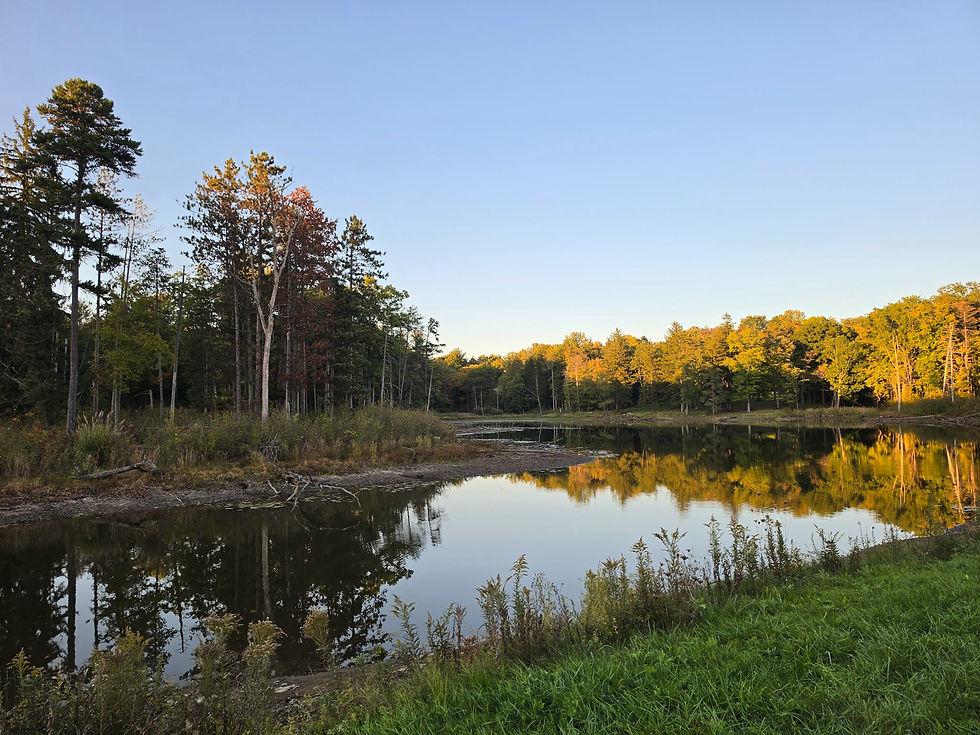
Kirby also manipulated the property's streams to create the lakes that remain among the preserve's most scenic features. Work on the lower lake began around 1920, while the upper lake—today known as Lake Linnea—was created in 1924. More than a century later, these man-made bodies of water look so natural against the surrounding forest that hikers unfamiliar with their history might never suspect they were engineered as part of a private estate.

Perhaps Kirby's strangest creation was Garfield Hall.
Built in 1923 near the head of the lower lake, the large recreation lodge was constructed using timber milled on the property. Beneath its dance floor, Kirby installed 12 industrial-sized springs, allowing the floor to flex beneath the feet of dancers. Family gatherings and company outings were held here, creating what must have been one of the more unusual private entertainment spaces anywhere around Cleveland during the 1920s.

That famous bouncing floor wasn't simply a local legend. When restoration work exposed the structure beneath the floor decades later, the massive springs were still there.
The Kirby era came to an end during the 1930s, just as another chapter was beginning. The Cleveland Girl Scout Council needed a permanent camp and raised more than $60,000 to acquire Kirby's estate. In 1937, the council purchased 243 acres and opened Camp Julia Crowell, named for the first commissioner of the Cleveland Girl Scouts. The camp was dedicated on June 20 and welcomed girls that summer.

Kirby's unusual estate proved almost perfectly suited for its new purpose. His former dance hall became the camp dining hall and was renamed Garfield Hall in honor of Eleanor Garfield, the Cleveland council's second commissioner. Kirby's house, mill, lakes and other structures became incorporated into camp life while cabins, shelters and additional facilities gradually appeared throughout the woods.

Camp Julia Crowell eventually became significant for reasons extending well beyond outdoor recreation. The Cleveland Girl Scout Council was an early advocate for racial and religious inclusion, and in 1943 Camp Julia Crowell became one of the first Girl Scout resident camps in Ohio to admit African-American girls. The camp also attempted to make its programs available regardless of socioeconomic background, an important part of the social history that later contributed to the property's recognition as a historic district.

The camp continued growing. In 1947 it hosted a World Encampment, bringing another dimension to a property that had evolved from pioneer farmland to private estate and then into an increasingly important Girl Scout camp. By the early 1950s, however, there was a problem: camping had become so popular that the Cleveland council simply didn't have enough room.

That brings the story—and the hike—into the northern half of today's preserve.
Immediately north of Camp Julia Crowell was another remarkable property. Clarence J. Neal had purchased the former Freeman farm in 1918 and established Neal Fruit Farm. The property became known for its orchards, while the Neal family constructed several substantial homes overlooking what would become Lake Linnea. North House and the Coach House were built in 1928, while Amity House followed in 1936.

The old orchard is particularly interesting when hiking this portion of the preserve today. Historical accounts describe the property as having once contained one of Ohio's largest apple orchards. Much of that open agricultural landscape disappeared after the Girl Scouts acquired the property, and former orchard areas gradually returned to forest. In other words, some of the woods hikers pass through today occupy ground that looked dramatically different less than a century ago.
The Girl Scouts purchased the Neal family's remaining 93 acres in 1957, increasing the entire camp to its present 336 acres. One reason for acquiring the property was especially practical: the Neal land included the remaining portion of the upper lake. Protecting the watershed was important because pollution entering that lake could eventually move downstream and jeopardize swimming and boating elsewhere in camp.

The purchase also gave the Girl Scouts something unexpected—two beautiful lakeside homes, a coach house, landscaped grounds and remnants of the orchard. Troops began camping on the northern property in 1959, and on June 12, 1960, the new land was formally dedicated as Camp Hilaka. The name was associated with Lake Linnea, the "high lake" occupying this elevated northern portion of the property.
Amity House remains one of the most recognizable reminders of the Neal era. Built in 1936 for Herbert and Helen Neal, the handsome residence survived the transition from private property to Girl Scout camp and ultimately to public preserve. Together with North House and the Coach House, it gives this portion of the hike an unusual character—at times it feels less like a conventional park trail and more like you're wandering through a forgotten country estate hidden in the woods.

Camp Hilaka underwent its greatest transformation during the 1960s. After several years of fundraising, a major construction project was completed in 1967. It included George Gund Hall, the Louis D. Beaumont swimming pool, Chagrin Cabin, eight additional camping units and new water and sanitation infrastructure. A new boathouse followed in 1969.

Gund Hall became one of the principal gathering places on the Hilaka side of the property. Together with the swimming pool, cabins, shelters and lake, these facilities helped turn the northern property into a full-fledged resident camp where generations of Girl Scouts learned to swim, paddle, hike, camp and live outdoors.

Lake Linnea is still one of the highlights of hiking this portion of the preserve. Surrounded today by woods, the quiet lake offers one of the prettiest scenes along the route. Knowing its history makes it even more interesting: the lake originated as part of Kirby's reshaping of the estate in the 1920s, later helped motivate the Girl Scouts' purchase of the Neal property, and eventually became a centerpiece of Camp Hilaka.
As the decades passed, Camp Crowell Hilaka became the Cleveland-area Girl Scouts' principal outdoor program property. Girls came here for traditional camping but also participated in canoeing, backpacking and other outdoor programs. A National Senior Roundup was held here in 1968, and in 1972 a 40-person delegation from Japan stayed at the camp and planted a Japanese garden.
The Girl Scouts' presence also had an unintended effect on the landscape. For decades, these 336 acres were largely closed to the general public. Woods grew around old agricultural areas, former orchards faded into the forest and nature gradually reclaimed portions of the property. Today, the preserve consists of a series of wooded stream valleys and spring-fed creeks, with terrain that becomes noticeably more rugged south of Lake Linnea.

That's part of what makes hiking the Camp Hilaka Loop so enjoyable today. This isn't simply a walk through mature Northeast Ohio woods. Around almost every bend there seems to be evidence that something happened here before—a former camp road disappearing through the trees, an old building beside the trail, a lake that turns out to be man-made, a historic home overlooking the water or a clearing that once belonged to a sprawling orchard.

The Girl Scout era finally ended when Camp Crowell Hilaka closed in 2011. Rather than allowing the historic property to disappear into private development, Richfield residents ultimately supported its preservation. The land was acquired for public use and became Richfield Heritage Preserve, opening a property that had been largely inaccessible to the general public for more than 75 years.
In 2020, the entire property was listed on the National Register of Historic Places as the Camp Crowell Hilaka Historic District. The designation recognizes not only its unusual collection of historic buildings and recreational structures but also its importance to the social history of the Girl Scout movement, including the Cleveland council's efforts toward racial integration, religious inclusion and making outdoor experiences available to girls from different economic backgrounds.

Today, hiking the Camp Hilaka Loop offers a chance to explore all of those layers at once. What begins as a walk through a quiet forest gradually reveals itself as a journey through more than two centuries of Richfield history—from pioneer farms and James Kirby's eccentric country estate to apple orchards, Girl Scout camps and finally a public preserve.
And that's really what makes this hike so much fun.
There isn't one single attraction that defines it. Instead, the enjoyment comes from wondering what you'll find around the next corner. Historic homes appear through the trees, old camp facilities sit quietly where generations of Girl Scouts once gathered, Lake Linnea reflects the surrounding forest and remnants of the property's former lives are scattered throughout the landscape.
For decades, these woods were filled with campers learning how to paddle a canoe, build a fire, follow a trail or simply spend a night outdoors. Today the campfires have largely disappeared and the old camp roads have become hiking trails, but much of Camp Crowell Hilaka remains remarkably intact. Hiking through it feels less like visiting a conventional park and more like being given permission to explore a place that had been hidden from the public for generations.
With numerous intersecting trails and offshoots throughout the preserve, hikers should consider downloading a map beforehand to help stay on the correct route.


Comments