
Alder Trail: Exploring the Hidden History of Goodyear Heights Metro Park

Located on Akron's east side, Goodyear Heights Metro Park is one of the oldest parks in the Summit Metro Parks system, offering a peaceful escape into a landscape filled with wooded trails, wetlands, and interesting local history. Among its hiking trails, the 1.4-mile Alder Trail is especially appealing, winding through a beautiful hardwood forest before reaching Alder Pond, a picturesque body of water surrounded by cattail marshes and abundant wildlife. Beyond its natural beauty, the trail offers an opportunity to explore a park whose history is closely connected to Akron's rubber industry, the Great Depression, and the transformation of former farmland into the forest visitors enjoy today.

Trail Info
Length 1.4 miles
Elevation gain 35 feet
Route Loop
Permit required No
Dogs allowed On leash
Trailhead elevation 1,070'
Water water spigots 0.1 miles into the hike
Don't miss sunrise from Alder Pond
Hiking the Alder Trail
The hike begins at the Pioneer Area parking lot, located at 550 Frazier Avenue, where visitors will find access to the Alder Trail.

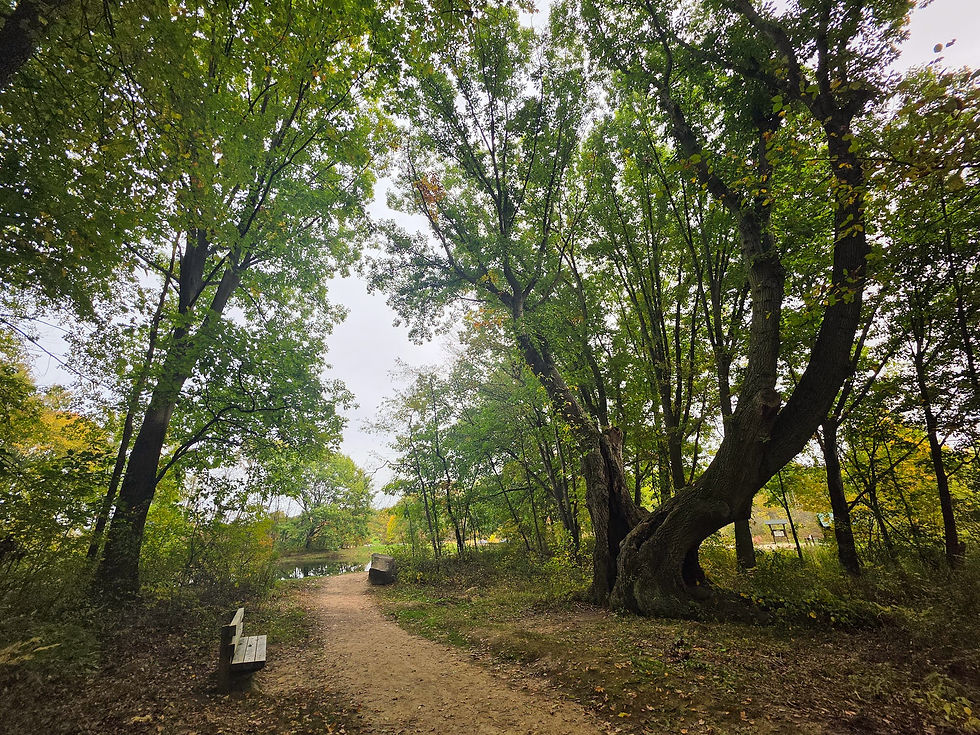
From the trailhead, the route enters a forest filled with mature hardwoods, offering a welcome contrast to the surrounding residential neighborhoods. Although the park sits within one of Akron's more developed areas, the forest provides a fairly secluded atmosphere, particularly during the warmer months when the trees are covered in foliage.

As the trail winds through the forest, it's worth considering just how different this landscape looked a century ago. Goodyear Heights Metro Park traces its beginnings to December 1929, when the Goodyear Tire & Rubber Company donated two parcels of land to the Akron Metropolitan Park Board. The donation was announced in the Akron Beacon Journal on Christmas Day, providing the foundation for what would become one of Summit County's earliest metro parks. The park district also purchased 37 acres from local resident Gilbert Waltz, whose property had previously been used for farming.


Officially established in 1930, the park continued expanding during the Great Depression through the acquisition of properties with delinquent taxes, while additional donations from Goodyear during the 1950s helped shape its present-day boundaries.
The park's name reflects its connection to the Goodyear Tire & Rubber Company, which was founded in Akron in 1898 by brothers Frank and Charles Seiberling. The company was named in honor of Charles Goodyear, whose development of the vulcanization process revolutionized the rubber industry. At the time the park was established, Akron was internationally recognized as the Rubber Capital of the World, and Goodyear was among the companies responsible for the city's extraordinary industrial growth. The creation of Goodyear Heights Metro Park reflected a growing effort to preserve green space for residents of an increasingly industrialized city.

Interestingly, much of the forest surrounding the park's trails is the result of deliberate reforestation efforts rather than uninterrupted natural growth. During the 1930s, thousands of pine and tulip trees were planted across former agricultural fields, with local Girl Scout troops participating in the effort.
Over the following decades, many of these planted areas gradually developed into more diverse woodlands as native hardwoods began replacing the original trees. Today, the park supports a mixture of oak, maple, beech, black cherry, and tulip trees, providing a glimpse into how dramatically a landscape can change in less than a century.
Continuing along the Alder Trail, the forest eventually gives way to one of the park's most recognizable natural features, Alder Pond. The trail takes its name from this small body of water, which is bordered by wetlands and thick stands of cattails. Although the precise origin of the pond's name is not well documented, it's likely associated with alder trees, a group of moisture-loving trees and shrubs commonly found near streams, ponds, and marshes. Their ability to thrive in damp soils makes them particularly well suited to wetland environments like those surrounding the pond.

Alder Pond has also been a popular recreational destination for generations. Historical photographs preserved by Summit Metro Parks show residents fishing along its shoreline as early as 1949, when the pond was already a familiar gathering place for local families.

Over time, however, sediment gradually accumulated along its edges, reducing water depth and affecting the aquatic habitat. In 2015, Summit Metro Parks undertook an extensive restoration project, removing accumulated sediment, installing large boulders, and replacing an artificial retaining wall with a more natural shoreline. The following spring, approximately 1,000 fish were introduced into the restored pond, including largemouth bass, bluegill, redear sunfish, and channel catfish. The project helped revive a recreational tradition that had been part of the park for decades.

One of the highlights of hiking the Alder Trail is the boardwalk and observation area overlooking the cattail marsh near Alder Pond. This wetland provides valuable habitat for numerous species of wildlife, making it one of the best places in the park to stop and observe the natural surroundings. Muskrats inhabit the marshy shoreline, while mallards and Canada geese are frequently seen on the water. During warmer months, visitors may also encounter snapping turtles basking in the sunshine, some of which can weigh more than 20 pounds. The surrounding wetland vegetation, including sphagnum moss and moisture-loving trees, adds another layer of diversity to an already interesting landscape.

Beyond the pond, the Alder Trail continues through the park's woodland environment, offering more opportunities to appreciate the forest before returning toward the Pioneer Area. Although the hike is relatively short and considered easy, its combination of hardwood forest, wetlands, and wildlife makes it one of the more rewarding nature walks in this section of Akron.

The park's history extends beyond its forest restoration and connections to the rubber industry. During World War II, portions of the former Waltz farm along Newton Street were converted into Victory Gardens sponsored by the Goodyear Tire & Rubber Company. The gardens allowed local residents and employees to grow vegetables during a period when food rationing and wartime shortages were common. Following the war, the gardens continued serving the community, preserving an agricultural tradition that stretched back to the property's earliest farming days.


Another interesting chapter occurred in 1957, when the Charles Goodyear Memorial Pavilion was constructed near the park's main entrance. The building served as headquarters for the entire Summit Metro Parks system until 1974, when administrative operations relocated to Sand Run Metro Park. Today, the pavilion remains a reminder of the park's importance during the early development of Summit County's extensive network of protected natural areas.

As the Alder Trail approaches its starting point, the surrounding forest offers one final reminder of how dramatically this property has changed since its establishment nearly a century ago. What was once a mixture of farmland, planted trees, and industrial-era recreational space has developed into a thriving natural landscape where visitors can explore quiet woodlands and wildlife-filled wetlands.
For anyone looking for an easy hike in Akron with an interesting blend of nature and local history, the Alder Trail at Goodyear Heights Metro Park is well worth exploring.


Comments