
Hiking the Cascade Arbor Trail: Waterfalls, Hobos & Underground Railroad History

Tucked away in a quiet residential neighborhood just west of downtown Hudson, Cascade Park offers a surprisingly scenic hike through mature woodlands, alongside a picturesque stream, and past two small waterfalls hidden among rocky ledges. The Cascade Arbor Trail is an enjoyable woodland walk, but what makes this hike particularly interesting is the history surrounding it. From its connection to a prominent 19th-century abolitionist to stories of railroad hobos bathing beneath its waterfalls, this little-known park has a fascinating past that most visitors are completely unaware of.

Trail Info
Length 0.7 miles
Elevation gain 45 feet
Route Loop
Permit required No
Dogs allowed On leash
Trailhead elevation 1,070'
Water none
Don't miss visiting in springtime or after periods of heavy rainfall
Hiking the Cascade Arbor Trail
The hike begins at Cascade Park's parking area off Lynn Drive, where visitors will find a large parking area, restrooms, a playground, and a picnic pavilion.

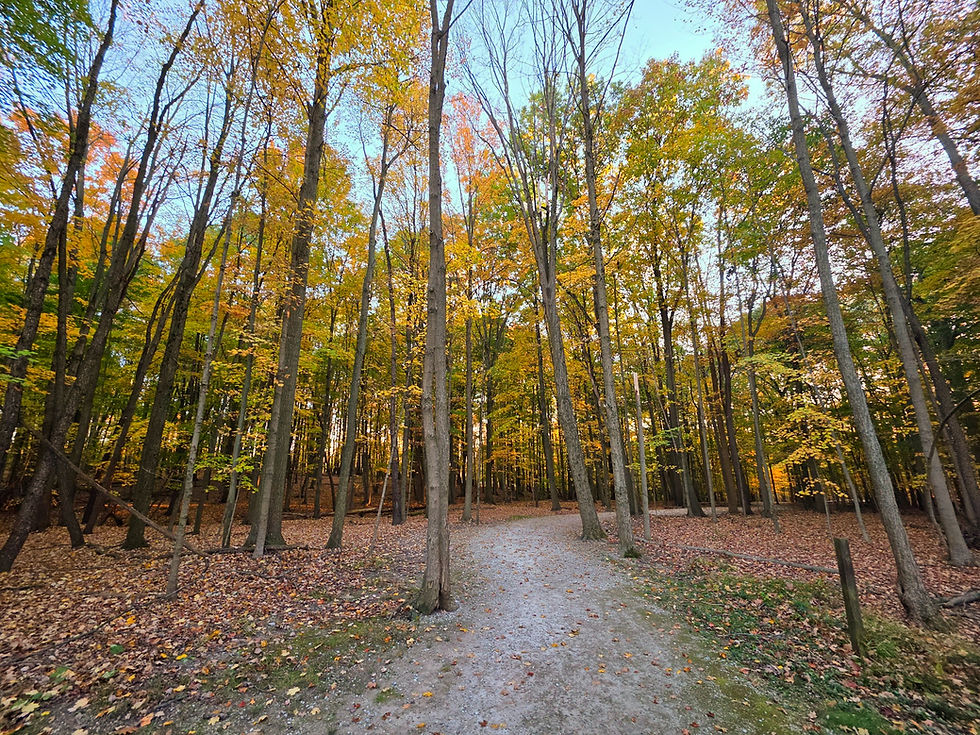
Although the developed portion of the park has the appearance of a typical neighborhood recreation area, the landscape changes considerably once you enter the woods. The Cascade Arbor Trail leads away from the park's open spaces and into a peaceful forest that feels surprisingly secluded considering its proximity to downtown Hudson.

Following the trail clockwise, the route winds through a mixture of hardwood trees and gently rolling terrain. Depending on the season, the forest floor is covered with spring wildflowers, summer greenery, or a thick blanket of fallen leaves. The surrounding forest provides a nice escape from the more developed portions of the park, while the occasional sound of flowing water hints at one of the area's most interesting natural features.
Long before Cascade Park became a public recreation area, the surrounding property was part of Hudson's early agricultural landscape. The land was originally included in Lot 34, one of the parcels established during the township's first survey in 1799. During the early 19th century, the property came into the possession of John Bushnell Clark, a prosperous farmer and outspoken abolitionist who moved to Hudson with his family in 1835, where he lived until his passing in 1872.

Clark, a privateer in the War of 1812, owned considerable acreage in the community, including the land that would eventually become Cascade Park. His former residence, known as 5 Thirty Acres, still stands along Darrow Road and has an intriguing connection to Hudson's antislavery history.

During renovations of the historic house, workers reportedly discovered a concealed crawl space between the first and second floors, accessible by small ladders. The unusual feature led to speculation that Clark may have used the space to shelter freedom seekers traveling north along the Underground Railroad. Even more remarkable were the property's subterranean secrets: local land records and historical accounts indicate that a secret tunnel ran from beneath the house directly to a neighboring property across the street, offering a covert escape route if the home was ever breached.
Clark was far from alone in his opposition to slavery. During the decades leading up to the Civil War, Hudson had become a stronghold of the abolitionist movement, earning a reputation as a "citadel of abolitionism." Among its most prominent figures was Owen Brown, father of the famous abolitionist John Brown, who operated an Underground Railroad station and helped establish the antislavery Free Congregational Church in 1842. John Brown's half-brother, Jeremiah Root Brown, also sheltered freedom seekers at his farmhouse at 204 East Streetsboro Street, where a concealed cistern reportedly provided a hiding place. Other notable residents included Hudson's founder, David Hudson, whose family assisted escaping enslaved people as early as 1826, and Western Reserve College professors Beriah Green and Elizur Wright, who became outspoken advocates for immediate emancipation. Together with figures such as Chauncey and Cleopatra Case, these individuals helped establish Hudson as an important stop along the Underground Railroad, where freedom seekers could find shelter and assistance on their journey north toward Canada.
As the Cascade Arbor Trail continues through the forest, it is difficult to imagine that this quiet landscape was once closely connected to the railroad industry. During the 19th century, a railroad corridor passed through the property, bringing travelers and commercial activity to the surrounding area. Railroads played an important role in Hudson's development, although the town's early enthusiasm for railroad investments also had disastrous financial consequences. When a local railroad enterprise collapsed in 1857, numerous residents suffered substantial losses, with some reportedly losing their life savings.

The railroad's presence also gave rise to one of Cascade Park's more unusual historical stories, one involving the waterfalls that remain hidden in the woods today.
Near the beginning and again toward the end of the walk, the trail passes close to areas where Cascade Park’s two waterfalls can be found. Although neither is particularly large, both cascade over rocky ledges into wooded ravines, creating a surprisingly scenic setting that feels tucked away from the surrounding landscape.

The larger of the two waterfalls was historically known as Picnic Falls, a name given to the location by Alan and Katherine MacLaren, who purchased the surrounding property in 1939. According to Katherine's recollections, preserved in the publication Pass It On: Oral Histories of Long-Time Hudson Residents, the waterfall had been a popular picnic destination for local families long before the MacLarens acquired the land. However, the most unusual part of her account involves the railroad travelers who once stopped here to bathe.
During the days when freight trains regularly passed through the property, hobos traveling aboard railroad boxcars would occasionally disembark and make their way to the waterfall. The basin beneath the larger cascade reportedly served as an improvised washroom, complete with a soap dish and soap. Travelers could wash themselves in the stream before returning to the railroad and continuing their journeys. It's a fascinating piece of local history, especially considering that the same secluded waterfall remains accessible to hikers today.

The property's transformation into a public park began in 1963, when Katherine MacLaren sold the 75-acre parcel to the Hudson Park Board. Two years later, Cascade Park was formally established as a neighborhood park, preserving the wooded ravines, waterfalls, and surrounding green space for future generations. Today, the park remains a popular destination for local families, walkers, and anyone looking for a short escape into nature.

Although the Cascade Arbor Trail is relatively short and easy, its combination of forest scenery, hidden waterfalls, and unusual history makes it one of Hudson's more interesting neighborhood hikes. What initially appears to be a simple walk through the woods becomes considerably more fascinating when you consider the generations of people who passed through this landscape, from early farming families and abolitionists to railroad travelers who once used its waterfalls as an outdoor bathhouse. For anyone interested in exploring Hudson's lesser-known natural and historical attractions, Cascade Park is well worth a visit.


Comments