_edited.png)
Hiking Towner's Woods: Ancient Hopewell Burials, Lost Artifacts, and 2,000 Years of History

Tucked away just outside Kent, Ohio, Towner's Woods Park is one of the most historically fascinating hiking destinations in Portage County. The park's Outer Loop takes hikers through beautiful old-growth forests, rolling hills, and wetlands, with scenic views of Lake Pippen, a glacial lake formed thousands of years ago. However, what makes this hike particularly remarkable is an ancient Hopewell burial mound overlooking the lake, where archaeologists uncovered human remains and an extraordinary collection of artifacts during excavations in the 1930s. With a history that includes prehistoric ceremonial traditions, mysterious missing artifacts, and a century-old railroad switching tower, Towner's Woods offers far more than a peaceful walk through the forest.
Trail Info
Length 3.3 miles
Elevation gain 180 feet
Route Loop
Permit required No
Dogs allowed On leash
Trailhead elevation 1,090'
Water None filterable
Don't miss the Hopewell burial mound
Hiking Towner's Woods Outer Loop
The hike begins at the Towner's Woods Park trailhead, located at 2264 Ravenna Road in Kent, Ohio. The 242-acre park, managed by the Portage Park District, features a network of interconnected natural-surface trails that wind through mature hardwood forests, open meadows, and wetlands. Although the park district does not officially designate a single Outer Loop, hikers can combine several of its trails to create a circuit around the property.

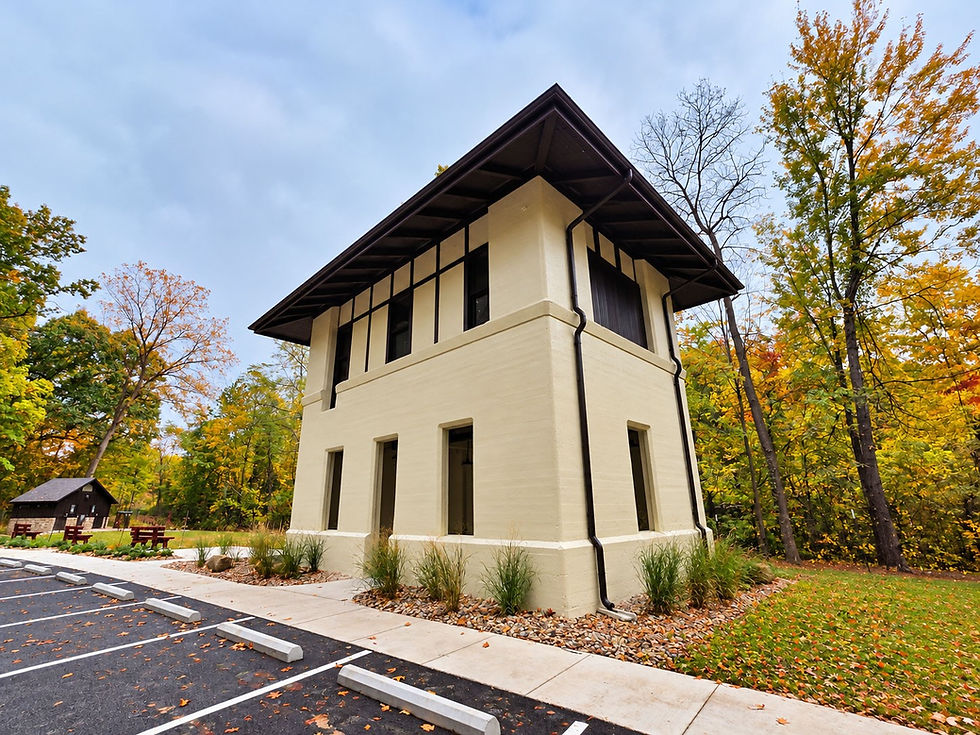
At the parking area stands the historic Brady Interlocking Railroad Tower, a small but interesting reminder of the region's industrial past. Constructed in 1913 and recently renovated, the tower once served the Erie Railroad, allowing railroad operators to control switches and signals along an important transportation corridor connecting communities throughout Northeast Ohio. As railroad technology advanced, towers like this gradually became obsolete, but the Brady tower survived and remains one of the park's most recognizable historic landmarks.
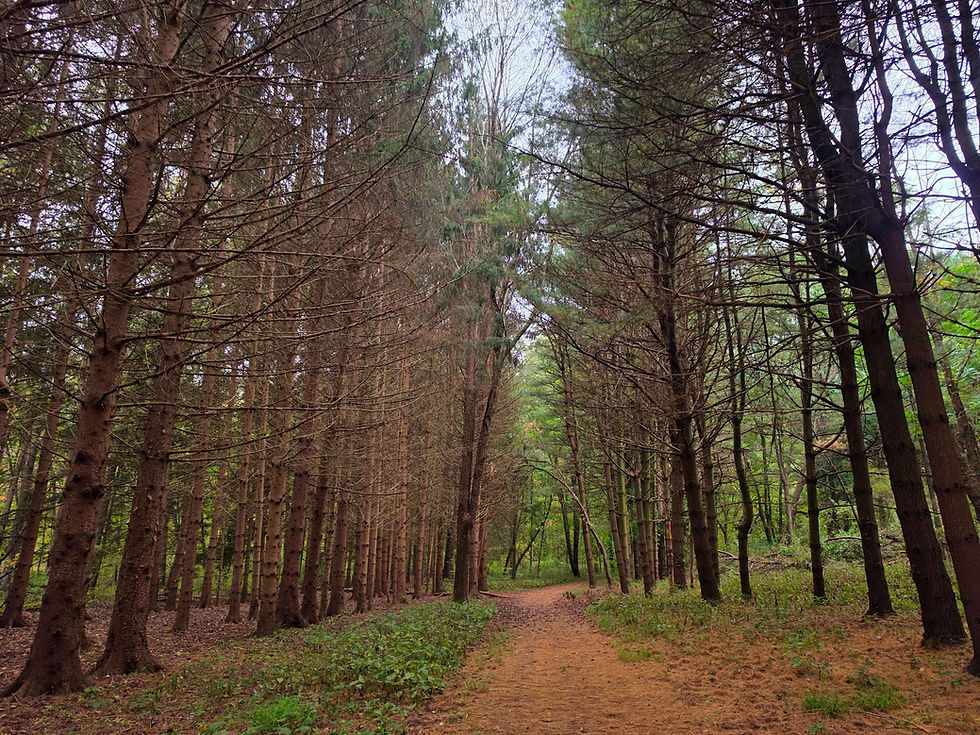
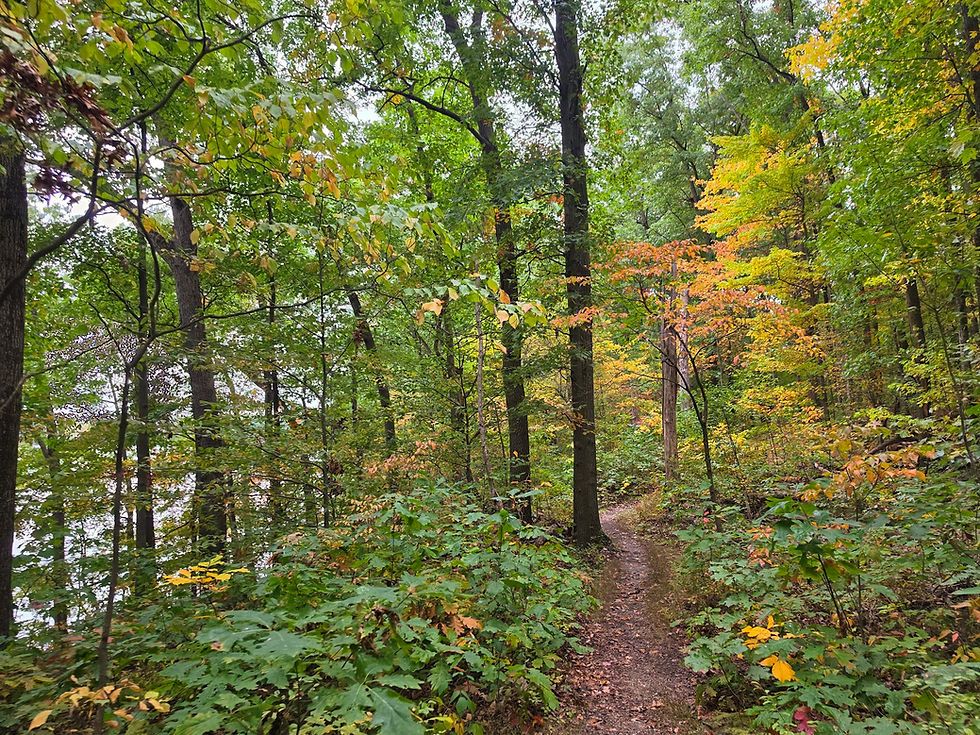
From the trailhead, the surrounding landscape quickly transitions into a beautiful hardwood forest dominated by oak trees. The terrain consists of gently rolling hills, while the trail alternates between broad woodland paths and narrower stretches winding through the trees.
What makes this forest particularly interesting is its remarkable preservation. Portions of the western forest contain black oak, scarlet oak, red oak, and white oak trees exceeding 100 years in age. Historical aerial photographs from 1937 show that this section of Towner's Woods was already a mature forest when much of the surrounding countryside had been cleared for farming and other uses.

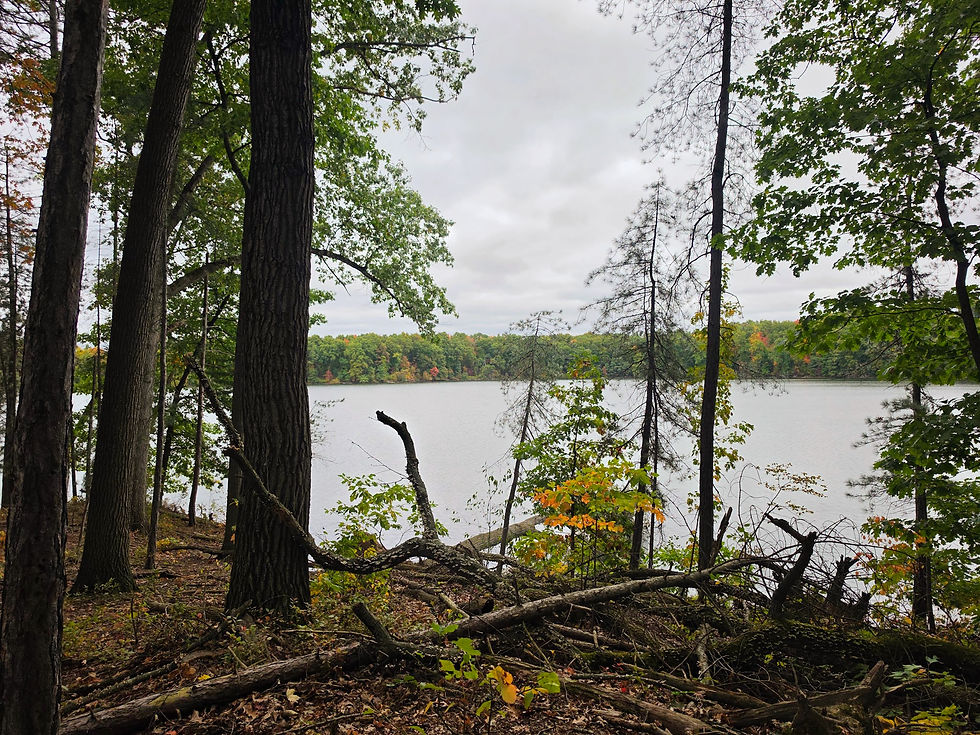
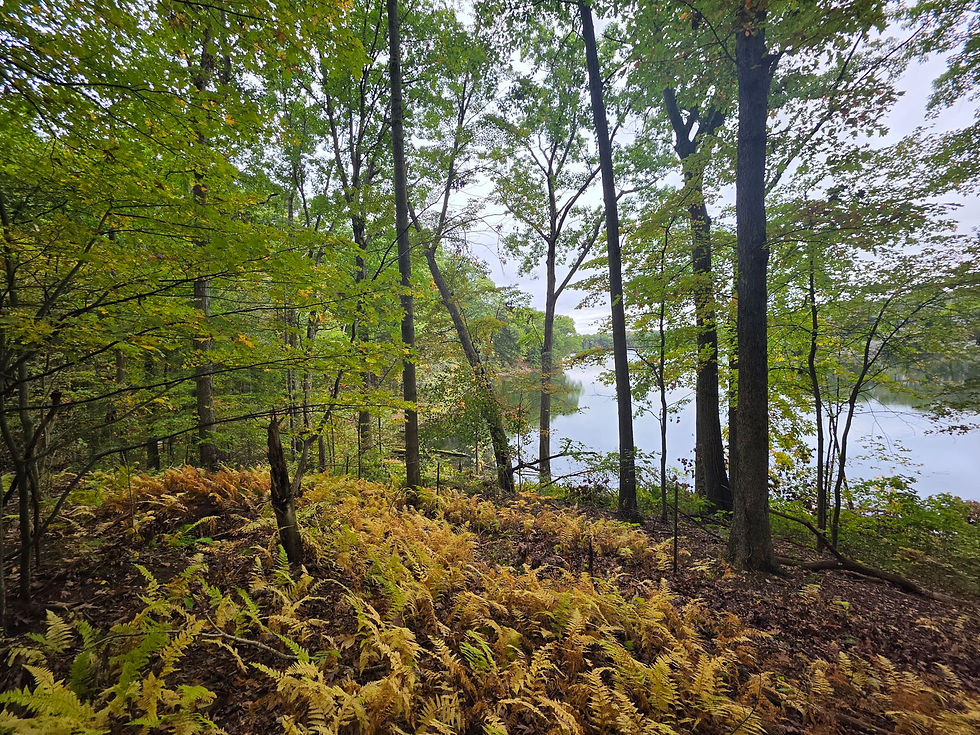
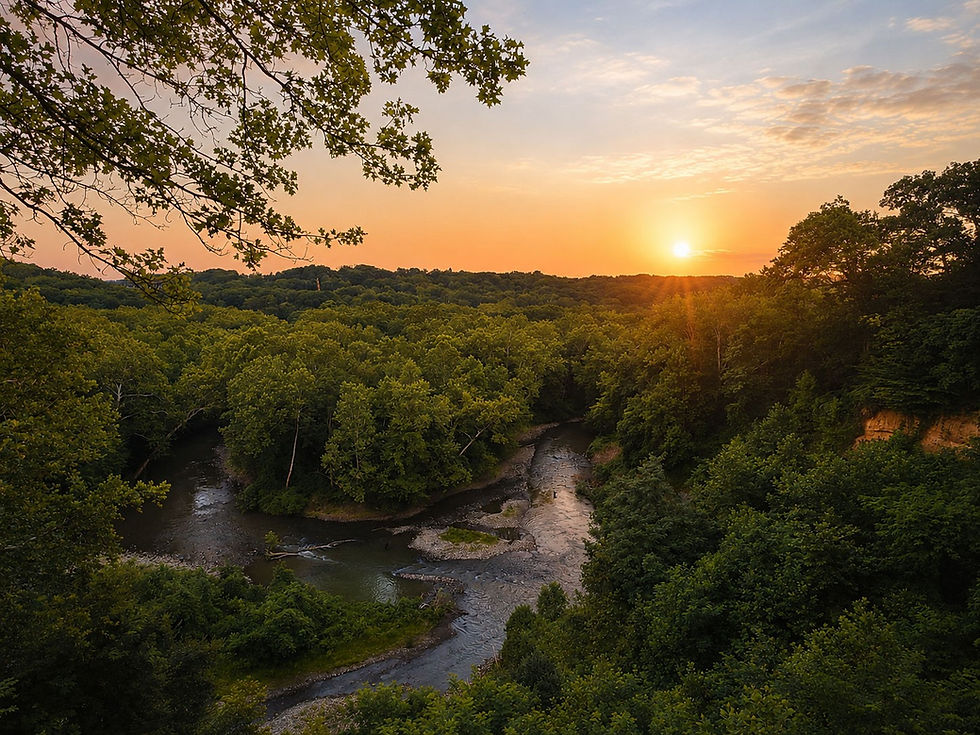
As the route approaches the northern portion of the park, hikers can enjoy beautiful views of Lake Pippen through the trees. The lake is a glacial kettle lake, formed when a massive block of ice left behind by retreating glaciers melted and created a depression that eventually filled with water. Today, the lake is owned by the City of Akron, and visitors are prohibited from accessing its shoreline.
Not far from this scenic landscape is the park's most significant historical feature: the ancient Towner Mound, a prehistoric burial site constructed by people associated with the Hopewell culture approximately 2,000 years ago. Most hikers walk right past it without noticing, as it blends almost seamlessly into the surrounding landscape. One of the easiest ways to spot it is to look for the split-rail fence surrounding its base.

Long before European settlers arrived in Northeast Ohio, Indigenous communities occupied the region, establishing settlements, developing extensive exchange networks, and constructing ceremonial earthworks. Among the most remarkable of these ancient cultures were the Hopewell, whose traditions flourished throughout much of Ohio between approximately 100 BCE and 400 CE.
The Hopewell are particularly famous for their enormous ceremonial earthworks and elaborate burial practices. Some of their most impressive surviving sites are located in southern Ohio, including the monumental earthworks near Chillicothe. However, evidence of Hopewell traditions has also been discovered throughout northern Ohio, including at Towner's Woods.
Situated on elevated ground overlooking Lake Pippen, Towner Mound is considered part of what archaeologists call the Hopewell periphery, referring to sites outside the cultural heartland of southern Ohio that exhibit Hopewell ceremonial traditions and distinctive artifacts.
The mound was constructed primarily from gravel and earth, and its location overlooking the lake may have held significance to the people who built it. Although the precise reasons for choosing this location remain unknown, the mound served as a burial place for multiple individuals, some of whom were interred with objects that likely held ceremonial, social, or personal significance.
For nearly two millennia, the mound remained hidden within the landscape. Its archaeological significance did not become widely recognized until a local landowner made an unexpected discovery in 1931.
The modern history of the mound began when George Towner, who owned the surrounding property, discovered an unusually shaped stone while digging on his land in 1931.
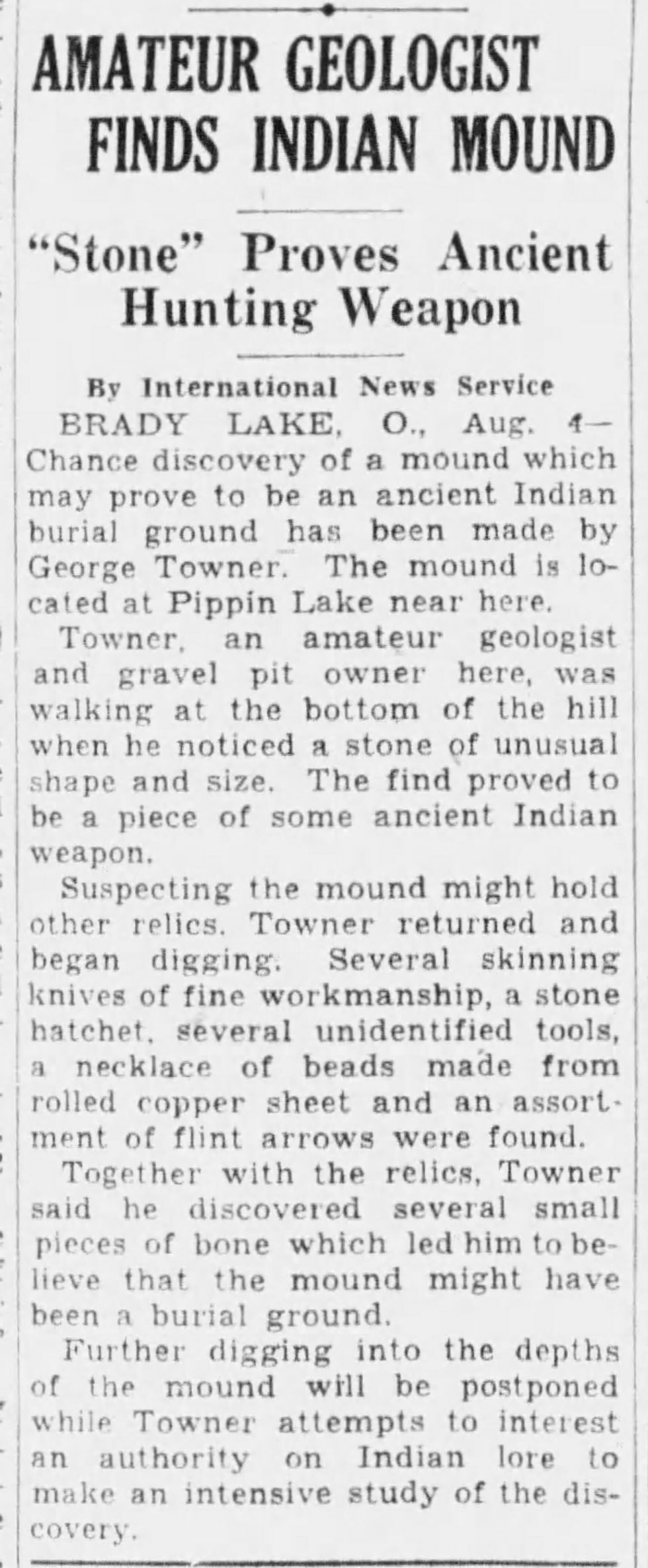
Upon closer examination, the object proved to be a stone celt, a prehistoric cutting or woodworking tool. Intrigued by the discovery, Towner continued digging and uncovered additional objects, including copper beads, flint projectile points, and stone knives.
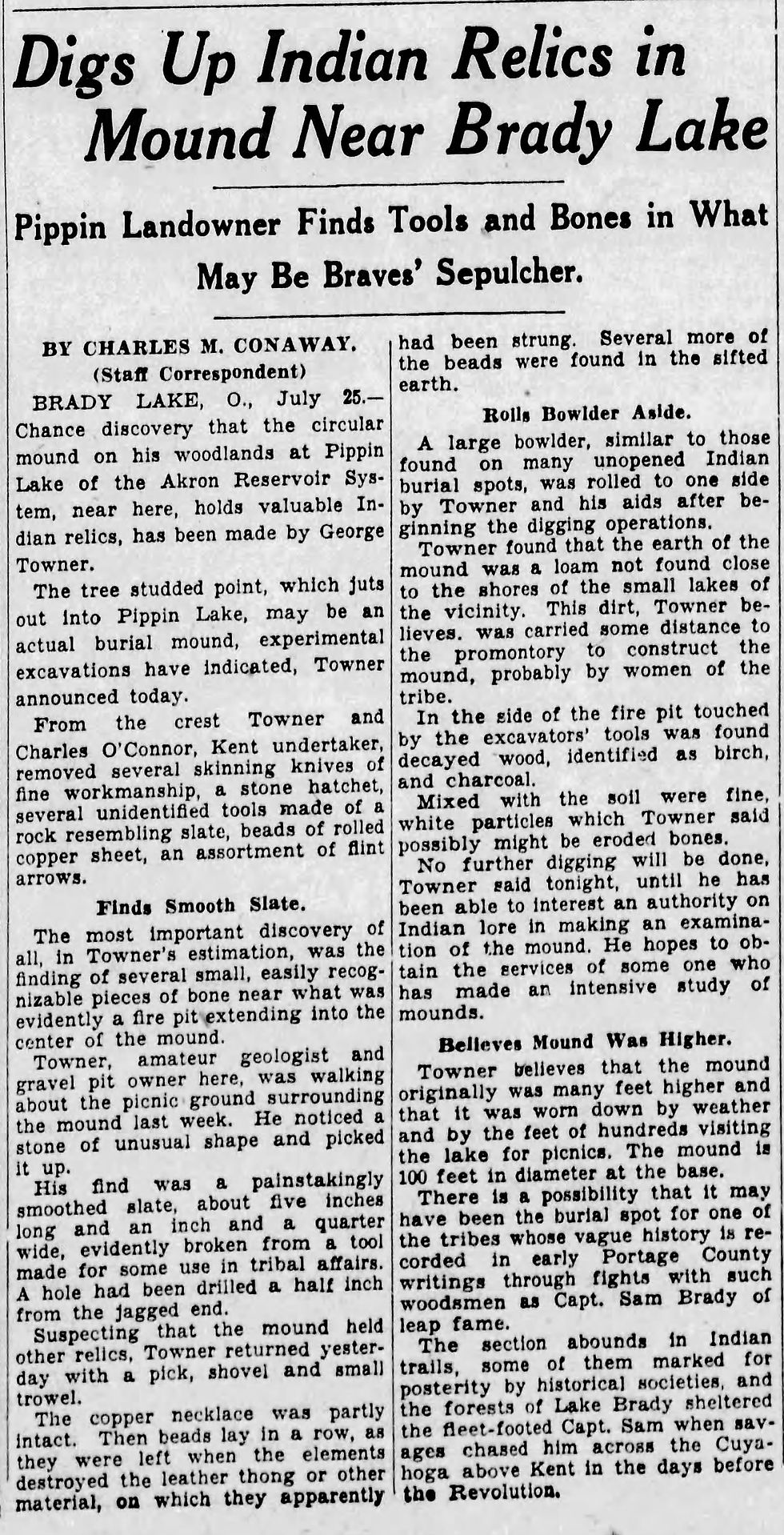
However, his investigation took a dramatic turn when he encountered evidence of a cremation burial. Recognizing that he had discovered something historically significant, Towner stopped digging and contacted the Ohio State Archaeological and Historical Society, now known as the Ohio History Connection.
The organization dispatched archaeologist Dr. Emerson Greenman to investigate the site, setting the stage for an excavation that would attract enormous public attention and reveal remarkable details about the people who lived in Northeast Ohio nearly 2,000 years earlier.
In 1932, Greenman began a systematic excavation of Towner Mound. What initially appeared to be a relatively modest prehistoric earthwork soon revealed a complex burial site containing multiple individuals and an impressive assortment of ancient artifacts.
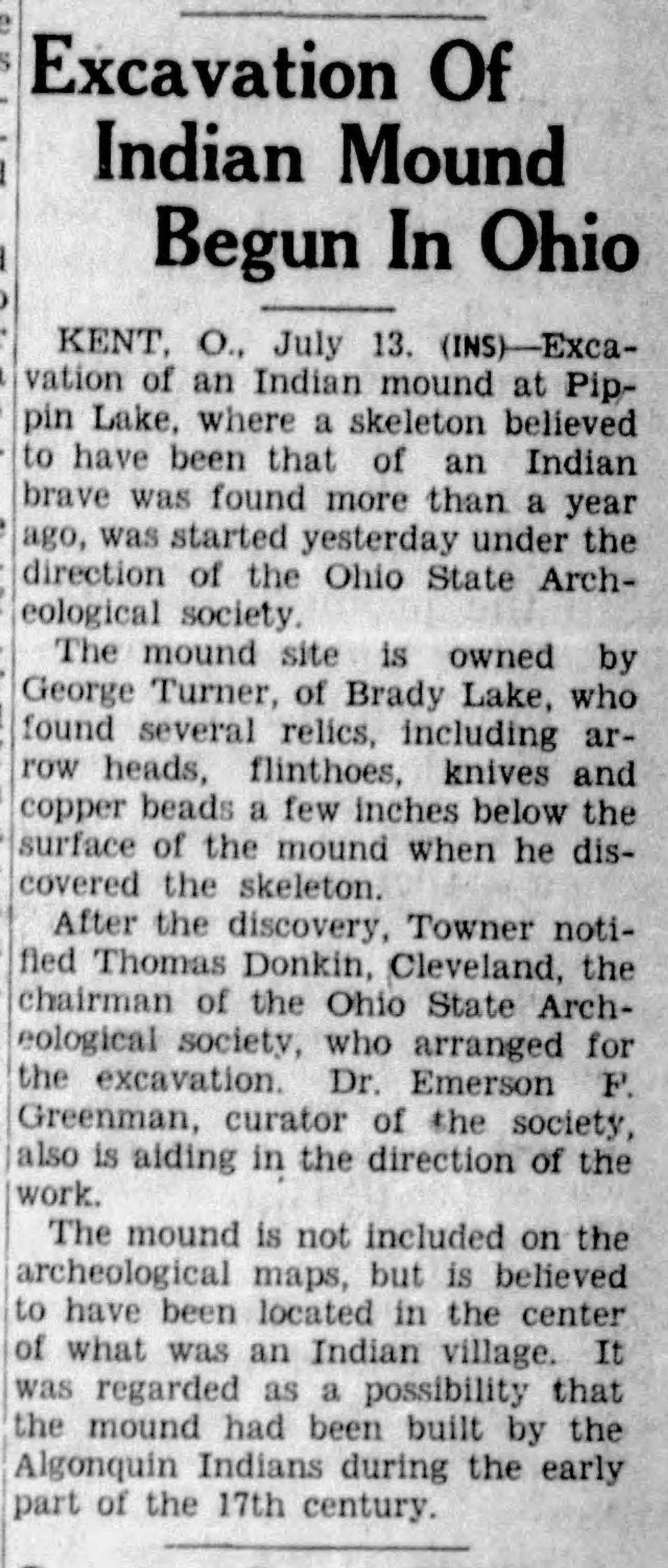
Exactly how many people were buried within the mound remains uncertain. Greenman's surviving field notes describe seven burials, while contemporary newspaper accounts and later archaeological research suggest the number may have been as high as eleven.
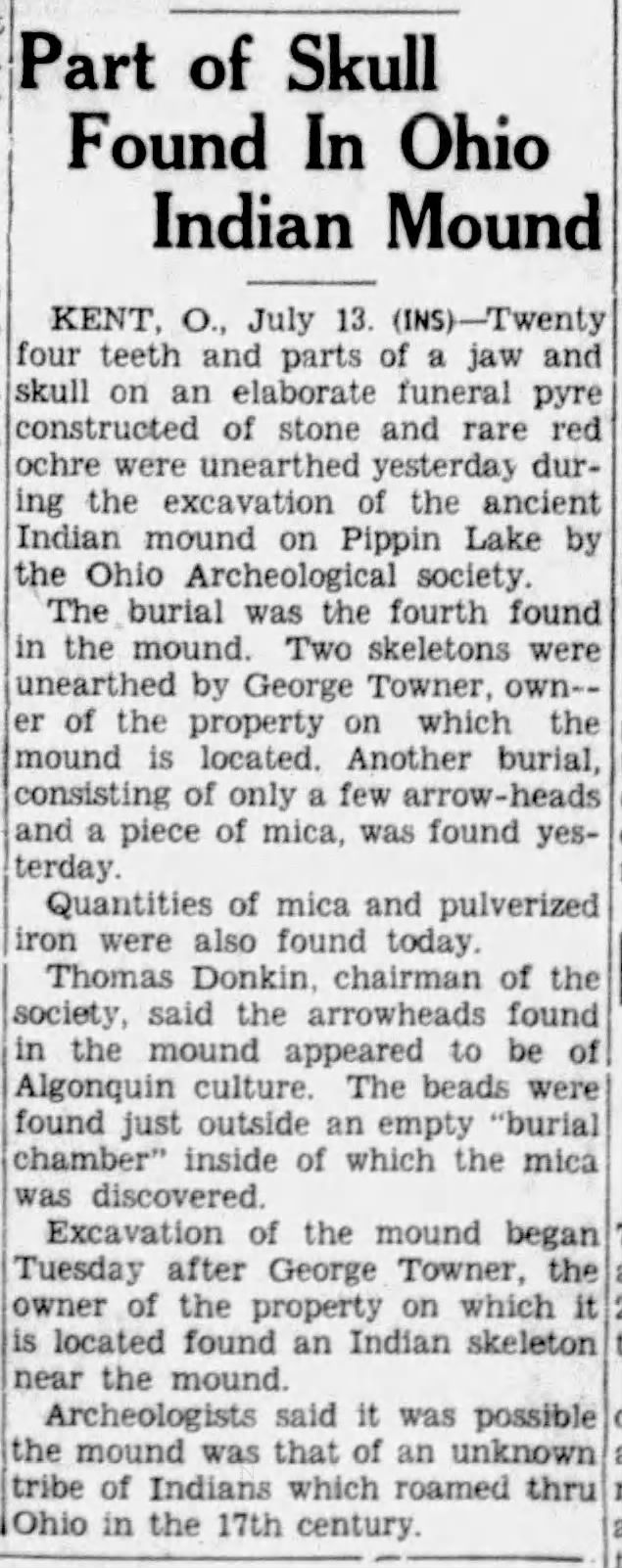
Many of the burials contained cremated remains, a practice associated with Hopewell ceremonial traditions. Others contained skeletal remains, although the preservation of these individuals varied considerably.

Because the mound had been constructed largely from gravel, water was able to penetrate the burial deposits over the centuries, contributing to the deterioration of much of the skeletal material. Despite these conditions, archaeologists uncovered a remarkable collection of objects that provided valuable clues about the mound's builders.
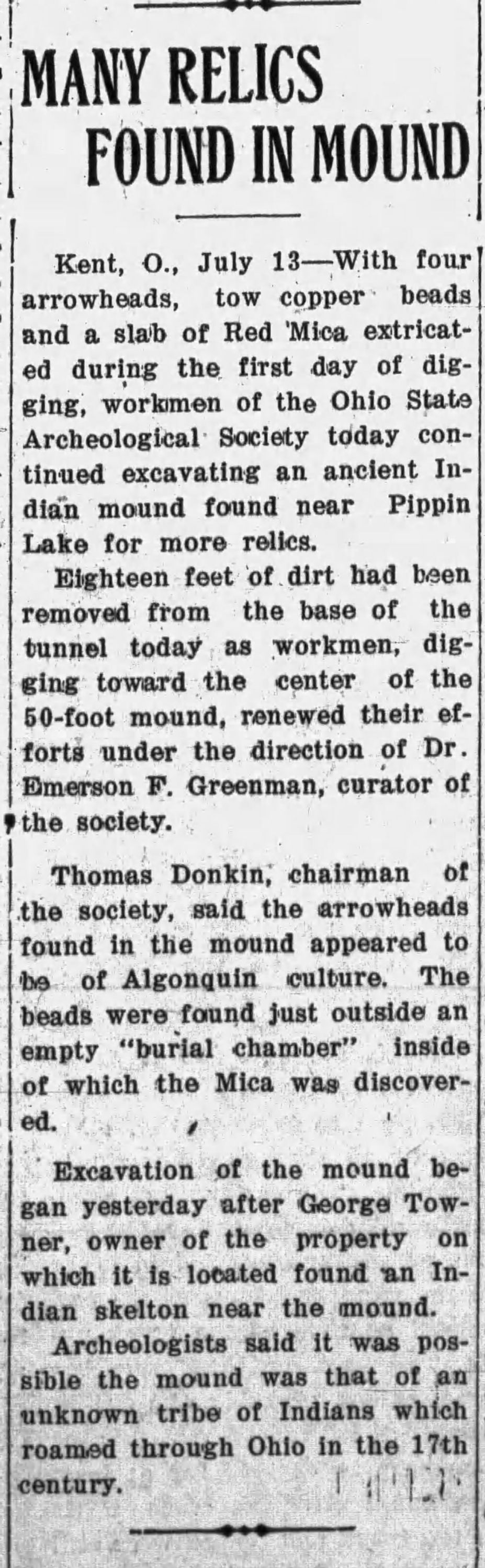
Among the discoveries were numerous tubular copper beads, likely worn as ornaments or incorporated into ceremonial clothing. The presence of copper is particularly interesting because Hopewell communities maintained extensive exchange networks that connected distant regions of North America.
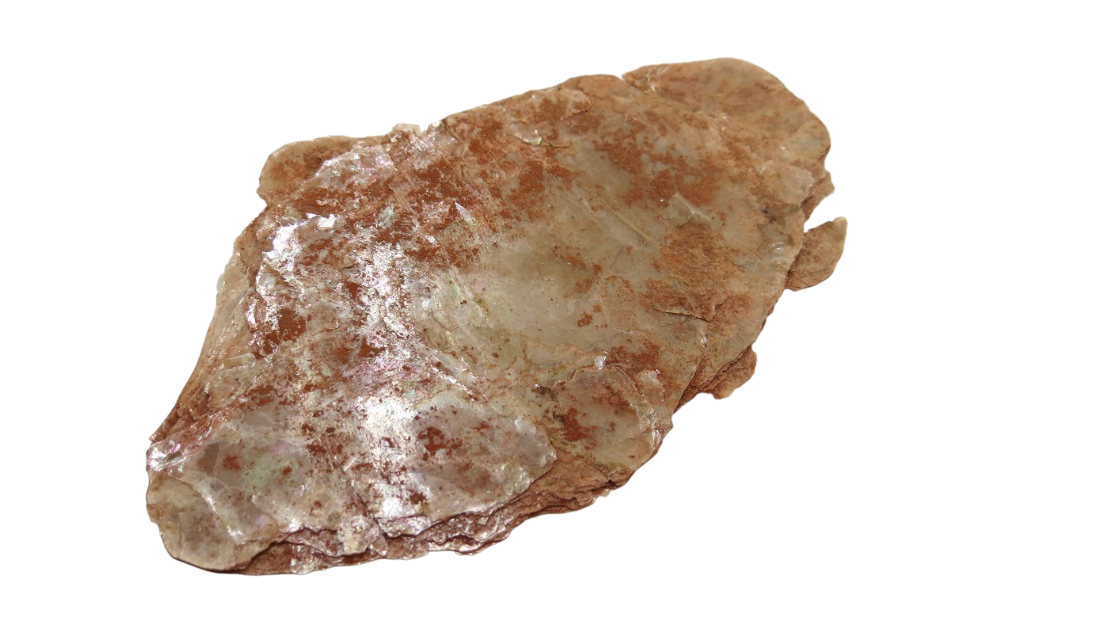
Archaeologists also recovered thin sheets of mica, a reflective mineral frequently associated with Hopewell ceremonial practices. One surviving piece appears to have been stained with red ochre, a natural pigment that was sometimes used in prehistoric burial ceremonies.

Several carefully shaped slate gorgets were also discovered. These flat stone ornaments were typically drilled with holes, allowing them to be suspended or attached to clothing. Although their precise purpose remains uncertain, they may have served as decorative objects, personal ornaments, or symbols of social identity.
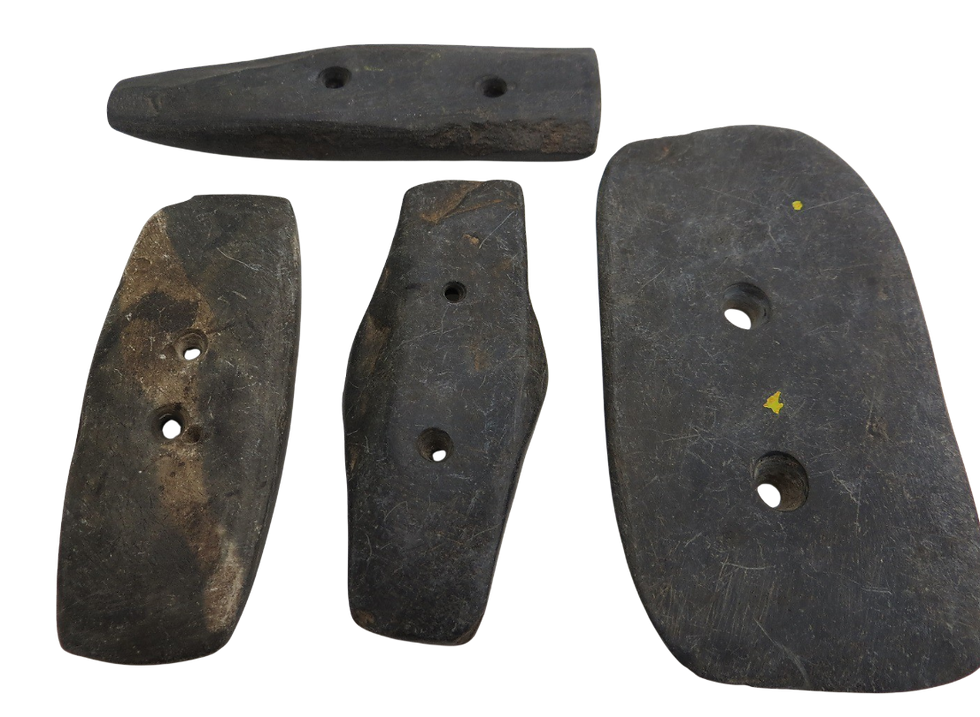
Other discoveries included pieces of graphite and mica, ground stone tools, flint flake knives, and projectile points manufactured from Upper Mercer flint.
Perhaps most significant were more than a dozen small stone bladelets made from Flint Ridge flint, a distinctive material originating from east-central Ohio. These carefully manufactured blades are strongly associated with Hopewell archaeological sites and helped researchers establish the mound's cultural affiliation.
Together, these discoveries demonstrated that the people buried at Towner Mound participated in traditions and exchange networks extending well beyond the immediate Cuyahoga River valley.
Among the individuals discovered during the 1932 excavation, one burial attracted particular attention because of its unusual preservation and accompanying artifacts. Historical accounts referred to the individual as the "Indian Princess," although this sensationalized nickname reflected the attitudes of the period rather than any verified social status.
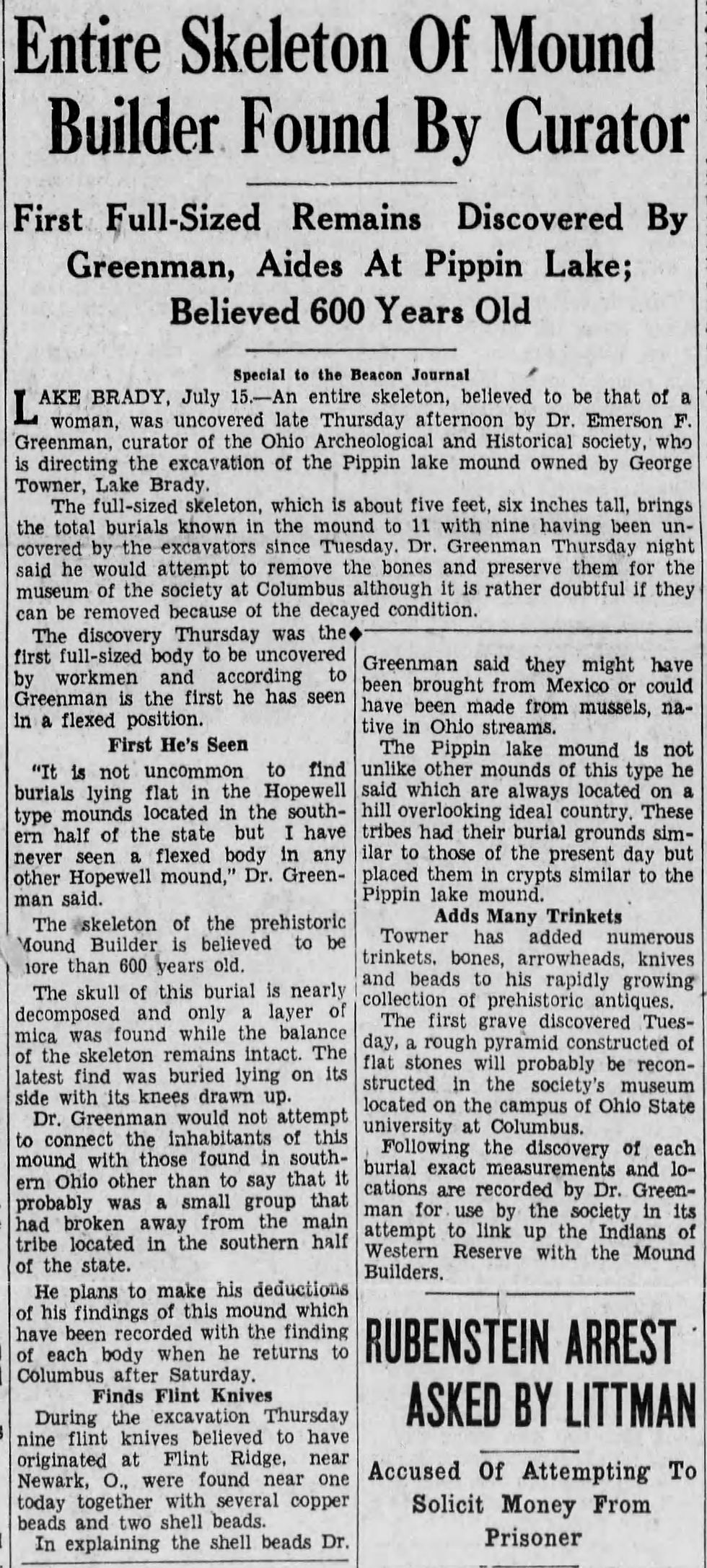
The individual, estimated to have been between 15 and 20 years old, had been placed in a flexed position, with the knees drawn toward the body. The burial was also covered by layers of interlocking flat stones, an arrangement that differed from many Hopewell burials documented in southern Ohio. Accompanying the remains were a rectangular slate gorget and a piece of mica.
The burial's unusual construction and associated objects led researchers to suggest that the individual may have held some special significance within the community. However, there is no archaeological evidence establishing that this person was royalty, and even the individual's sex remains uncertain. The discovery became one of the most widely discussed aspects of the excavation, but what happened afterward was arguably even more extraordinary.
According to historical research, George Towner eventually placed the remains in a glass-covered enclosure and charged visitors 25 cents to view them. After portions of the remains were reportedly stolen, Towner covered and reburied the individual.

Although such treatment would be considered deeply inappropriate by modern archaeological and ethical standards, the episode illustrates how differently ancient Indigenous burial sites were sometimes treated during the early 20th century.
The discoveries at Towner Mound generated tremendous public interest throughout the surrounding communities. The excavation took place during the Great Depression, when unemployment was widespread and unusual local events could attract enormous crowds. According to historical accounts, an estimated 2,000 spectators gathered to watch the excavation during its final days.
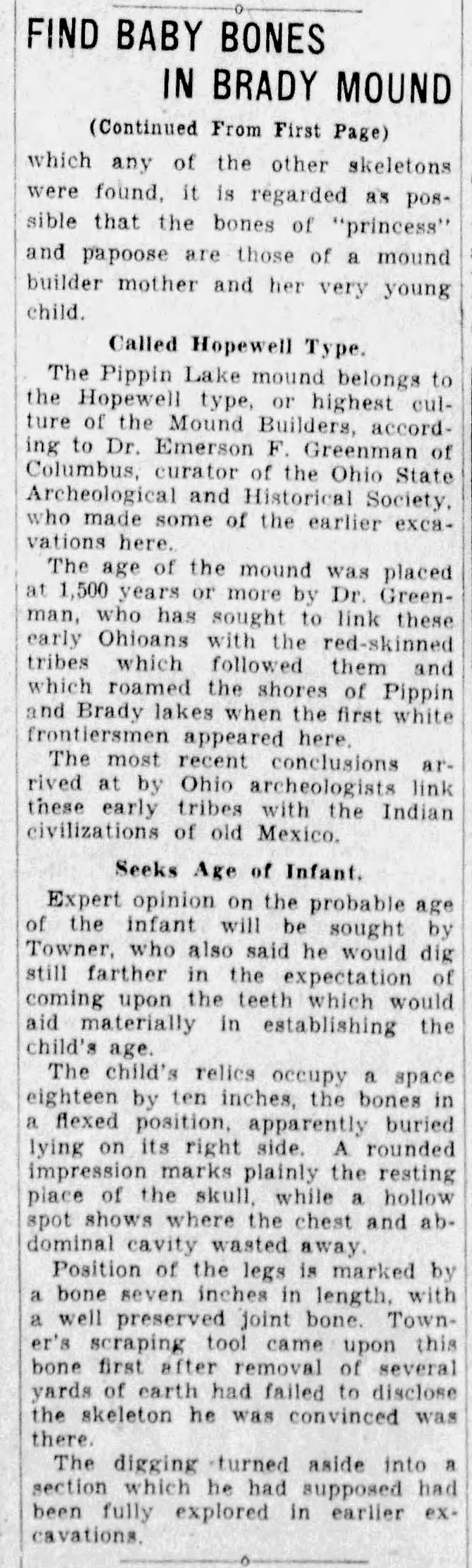
For a relatively small archaeological site in rural Portage County, the turnout was extraordinary. Unfortunately, the crowds also created problems for the archaeologists. Maintaining control of the excavation became increasingly difficult, and later researchers suggested that some artifacts may have been removed without proper documentation.
The confusion surrounding the excavation would become especially significant decades later, when archaeologists attempted to reconstruct exactly what had been discovered and where the recovered objects had gone.
One of the most intriguing aspects of Towner Mound's history is that many of the artifacts recovered during the 1932 excavation can no longer be accounted for.
Following the excavation, some of the objects were reportedly supposed to be transferred to the Ohio State Archaeological and Historical Society. However, later research indicates that the planned transfer did not occur as expected.
George Towner apparently retained some of the discoveries and considered creating a small museum inside the railroad switching tower on his property. That museum never materialized. Over time, the location of many of the recovered objects became increasingly uncertain.
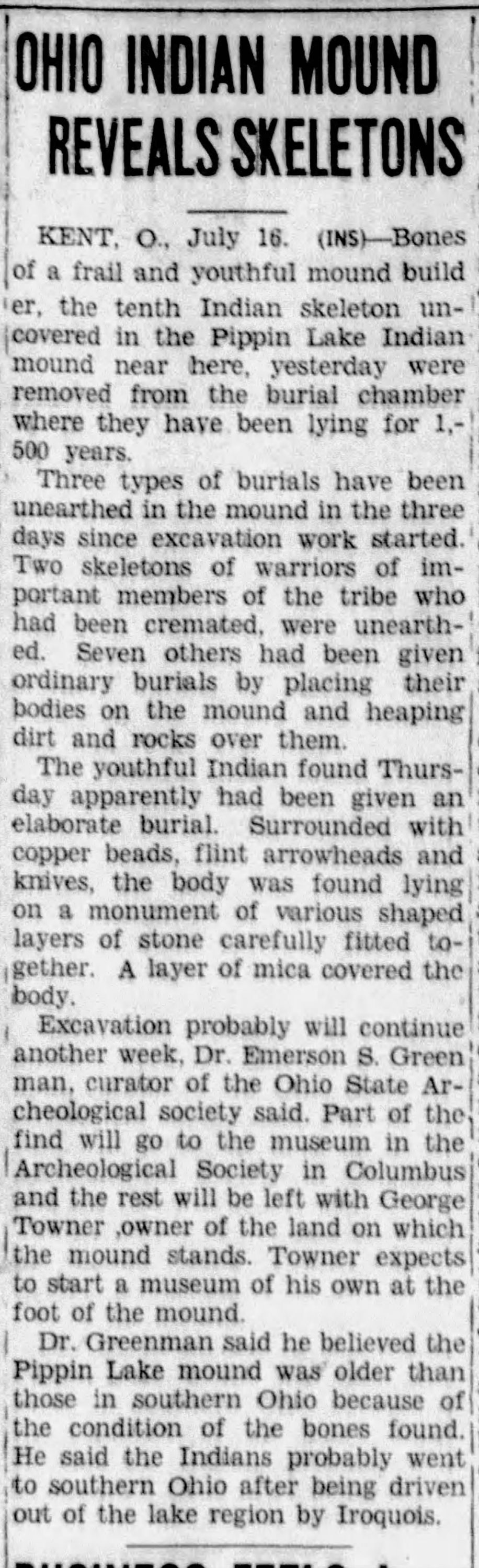
Today, surviving slate gorgets (armor that protects the throat) and mica sheets have been documented in the collection of the Portage County Historical Society. These objects provide a tangible connection to the mound and the people who constructed it nearly two millennia ago.
However, the whereabouts of numerous other artifacts remain unresolved, including much of the reported collection of copper beads, stone tools, flint blades, and other objects. The ultimate disposition of many of the human remains is also unclear in the surviving archaeological documentation.
This uncertainty does not necessarily mean the artifacts were stolen. Some may have remained in private collections, been transferred without adequate records, or become separated from their original documentation over the decades. Nevertheless, the incomplete records have made it difficult for modern researchers to fully understand the discoveries.

For archaeologists, an artifact's original location and relationship to surrounding objects can be just as important as the artifact itself. Once those details are lost, reconstructing the history of a burial site becomes considerably more difficult.
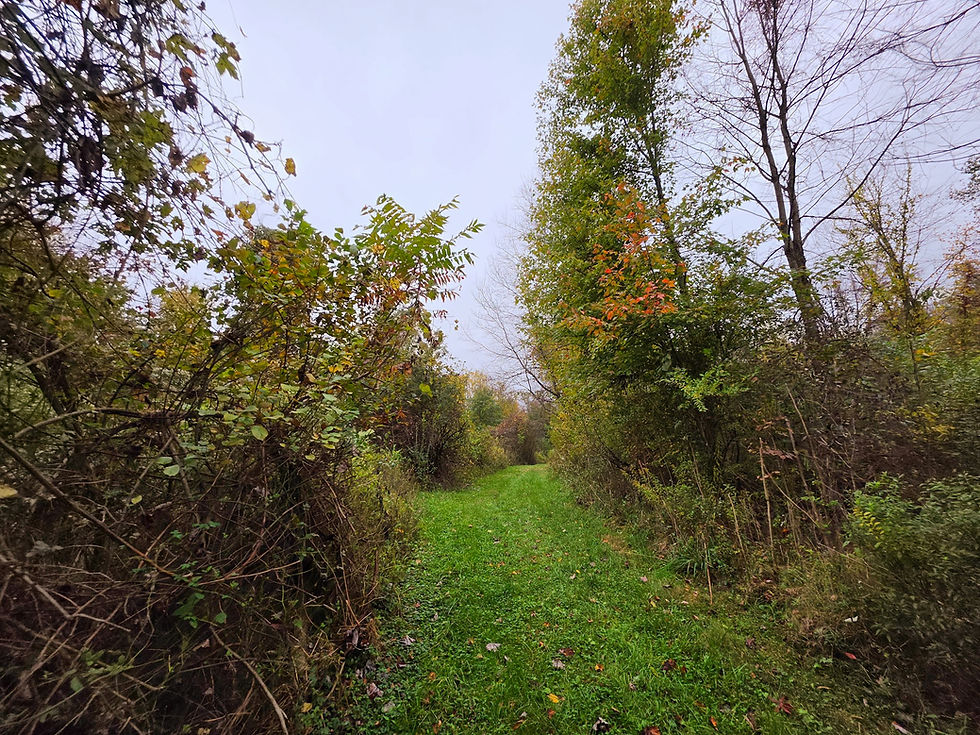
Returning to the Outer Loop, the surrounding forest provides another fascinating glimpse into the park's past. Much of the land that now makes up Towner's Woods has undergone dramatic changes over the last century. While the western old-growth oak forest remained relatively undisturbed, large portions of the central park were once open fields and pastures.
Historical aerial photographs show that these areas remained largely agricultural well into the 20th century. Grazing and intensive mowing did not completely cease until around 1985, allowing trees and native vegetation to gradually reclaim the former farmland.
Today, younger stands of red maple and wild black cherry occupy areas that were once cleared, while wetlands and vernal pools have recovered as the surrounding forest returned.
The eastern portion of the park contains an extensive bog that was historically drained for agricultural use. Over time, the wetland has recovered, providing habitat for specialized plants and wildlife, including tamarack trees.

The combination of forest, recovering farmland, and glacial wetlands creates an unusually diverse landscape within a relatively small park.
For hikers, the changing scenery is one of the most enjoyable aspects of the Outer Loop. The route moves between mature oak forest, younger woodland, rolling hills, and wetland environments, offering a constantly changing perspective of the park.
Towner's Woods is the kind of place where the history beneath your feet is every bit as fascinating as the scenery surrounding you. While the Outer Loop offers a peaceful hike through beautiful hardwood forests, rolling terrain, and scenic views of Lake Pippen, the ancient Hopewell burial mound gives the park a significance that extends far beyond its boundaries.
Nearly 2,000 years ago, Indigenous communities selected this landscape as a burial place for members of their society, leaving behind copper ornaments, stone tools, mica, and other objects that continue to intrigue archaeologists today. The dramatic excavations of 1932, the mysterious disappearance of many recovered artifacts, and the rediscovery of the site in 1972 only add to its remarkable story.
For hikers who enjoy discovering the forgotten history of Northeast Ohio, Towner's Woods offers a rare opportunity to explore a beautiful natural landscape while learning about the people who lived here long before the region became the communities we recognize today.


Comments