_edited.png)
Trail Lake Park's Kingfisher Way: A Peaceful Hike with a Surprising Past

Tucked away in Streetsboro, Ohio, Trail Lake Park is one of the hidden gems of the Portage Park District, offering peaceful woodlands, wetlands, scenic lake views, and a surprising amount of history. The park's Kingfisher Way Loop takes hikers through a beautiful landscape with connections to an ancient Native American travel route, Abraham Lincoln's journey to Washington, D.C., and a former commercial fish farm. Although the park only opened to the public in 2020, its history stretches back centuries, making it an interesting destination for hikers who enjoy discovering the stories behind the places they explore.

Trail Info
Length 1.5 miles
Elevation gain 105 feet
Route Loop
Permit required No
Dogs allowed On leash
Trailhead elevation 1,115'
Water none filterable
Don't miss hiking clockwise for sunset or packing a lunch/dinner and having it at the picnic table at the east end of Gessard Lake
Hiking Kingfisher Way
The hike begins at the Trail Lake Park parking area along Ravenna Road in Streetsboro, where visitors will find a paved parking lot, restrooms, and access to the park's trail system. Spanning approximately 222 acres, Trail Lake Park features several miles of trails winding through mature forests, open meadows, wetlands, and around a picturesque 30-acre lake.

The trail features mostly flat, gently rolling terrain with no steep climbs or descents, making for a relatively easy and enjoyable hike. Along the way, the scenery continually changes, adding variety to the experience.

The trail's name is inspired by one of the park's most fascinating feathered residents: the belted kingfisher. Recognizable by its shaggy crest, blue-gray feathers, and distinctive rattling call, this unusual bird is an expert fisherman that often perches on branches overlooking the water before diving headfirst to catch small fish. Belted kingfishers have been documented around Trail Lake Park, where the 30-acre lake provides an excellent feeding habitat. While hiking Kingfisher Way, keep an eye on the branches near the water, as you might just spot the bird that likely inspired the trail's name.

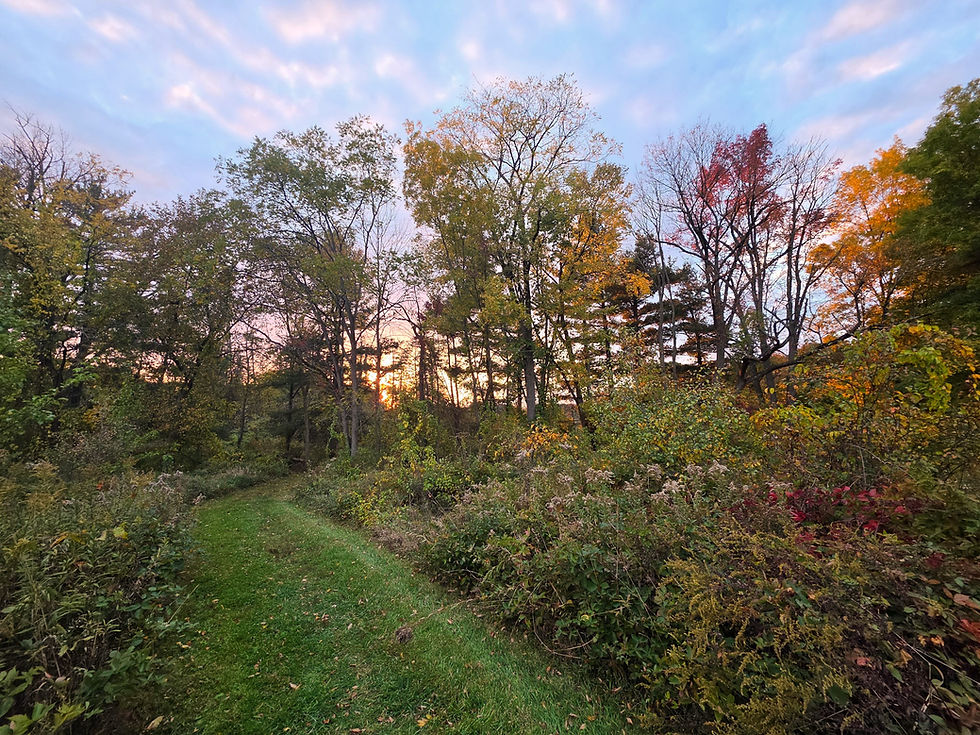
As the trail winds through the forest, hikers encounter a mixture of mature hardwood trees, younger woodland growth, and areas that were once agricultural fields. Over time, these former fields have gradually been reclaimed by nature, creating a patchwork of habitats that support a variety of wildlife. During the warmer months, the open areas are filled with grasses and wildflowers, while autumn brings colorful foliage to the surrounding hillsides.

One of the most interesting aspects of hiking through Trail Lake Park is knowing that people have been traveling through this landscape for centuries.
Long before European settlers arrived in northeastern Ohio, Indigenous peoples used an extensive network of footpaths to travel between settlements, hunting grounds, and trading locations. One of these routes was the Mahoning Path, a historic Native American trail believed to have passed through what is now Trail Lake Park.

The Mahoning Path connected portions of northeastern Ohio with destinations farther west, forming part of a much larger transportation network used long before modern roads existed. In fact, the park's name was chosen in recognition of this historic travel corridor.

Another remarkable chapter in Trail Lake Park's history involves one of America's most famous presidents.
During the 19th century, the Cleveland & Pittsburgh Railroad passed through the property, connecting communities throughout northeastern Ohio and providing an important transportation route for passengers and commercial goods.
In February 1861, President-elect Abraham Lincoln traveled through northeastern Ohio by train while making his way to Washington, D.C., for his first inauguration. His journey took him along the historic railroad corridor that once crossed what is now Trail Lake Park.
Today, portions of the park's paved Osprey Loop follow this former railroad alignment, allowing visitors to walk along a route associated with Lincoln's historic journey.
The railroad also played an important role in the region's early economy. Before mechanical refrigeration became widespread, ice harvested from nearby Twin Lakes was transported by train to Cleveland, where it was used to preserve food and keep businesses supplied with ice throughout the warmer months.
Although the railroad tracks are long gone, the former corridor remains an interesting reminder of the days when trains were essential to both commerce and transportation in northeastern Ohio.

As Kingfisher Way continues through the property, the park's centerpiece is never far away: a beautiful 30-acre lake surrounded by forest, wetlands, and open fields.

Unlike many of the natural lakes scattered throughout northeastern Ohio, Trail Lake was created by people.
In 1956, William "Bill" Gressard, a local conservationist and longtime nature columnist for the Record-Courier, excavated the lake on his family's property. Rather than creating it solely for recreation, Gressard established a commercial fish farm that supplied freshwater fish to restaurants throughout the region.
The operation raised bass and bluegill, which were harvested and sold to local businesses. What visitors now see as a peaceful recreational lake was once part of a working agricultural enterprise.
Gressard also had a deep appreciation for nature and conservation. Over the years, he and his family planted numerous trees throughout the property, helping establish portions of the woodland landscape that visitors enjoy today.

As the decades passed, the lake and surrounding property became increasingly valuable wildlife habitat. Wetlands developed along the shoreline, former agricultural areas began transitioning into meadows and young forests, and the lake attracted numerous species of waterfowl and other birds.
Today, visitors may encounter great blue herons, belted kingfishers, ospreys, and even bald eagles around the lake. The surrounding forests and meadows also provide habitat for songbirds, hawks, deer, and a variety of smaller animals.

Despite its natural beauty, Trail Lake Park nearly became something entirely different.
Following William Gressard's death, his family inherited the property, which remained privately owned for many years. Eventually, portions of the land were divided into potential residential building lots, raising the possibility that the lake and surrounding forests would become a housing development.
However, after Portage Park District voters approved the district's first operating levy in 2014, a member of the Gressard family approached park officials about preserving the property.
The family believed that protecting the land for future generations would have been consistent with William Gressard's wishes.
Rather than allowing the property to be developed, the park district worked to acquire the land, eventually combining approximately 130 acres from the Gressard estate with additional properties purchased from neighboring landowners and The Nature Conservancy.

The result was the creation of the 222-acre Trail Lake Park, which officially opened to the public on November 6, 2020.
What could have become another residential neighborhood was instead transformed into a protected natural area where visitors can enjoy the same forests, wetlands, and lake that the Gressard family cared for over several generations.

Beyond its history, Trail Lake Park plays an important role in protecting one of northeastern Ohio's more ecologically significant landscapes.
The property lies within the headwaters of Tinkers Creek, the largest tributary of the Cuyahoga River, and borders the remarkable Herrick Fen State Nature Preserve.
Unlike typical marshes and swamps, fens are uncommon wetlands sustained by mineral-rich groundwater. These unique conditions can support specialized plants and wildlife that are rarely found elsewhere in Ohio. By protecting the forests, wetlands, and waterways surrounding Trail Lake, the Portage Park District is helping preserve the ecological health of this larger landscape.

The park's combination of open water, mature woodland, wetlands, and former agricultural fields also creates an unusually diverse collection of habitats within a relatively small area.
For hikers, that diversity is part of what makes Kingfisher Way so enjoyable. Rather than following a single type of landscape from beginning to end, the trail passes through several different natural environments, each offering something new to discover.

As the hike continues, Kingfisher Way eventually reconnects with portions of the park's broader trail network before returning toward the parking area. Those looking to extend their outing can incorporate sections of the paved Osprey Loop, which circles the lake and offers additional opportunities to enjoy the scenery. A fishing pier and several shoreline viewpoints provide excellent places to stop, watch for wildlife, or photograph the lake.

Although Kingfisher Way is enjoyable throughout the year, autumn is an especially attractive time to visit. The surrounding hardwood forests provide colorful foliage, while the open meadows take on shades of gold and brown. Early morning visits can be particularly beautiful when calm conditions create reflections across the lake.

While Trail Lake Park might not have the towering sandstone cliffs or dramatic waterfalls found elsewhere in Northeast Ohio, it offers something equally appealing: a peaceful hike through a landscape with a remarkable story to tell.
From the ancient Mahoning Path and Abraham Lincoln's railroad journey to William Gressard's commercial fish farm and the property's eventual preservation, Kingfisher Way offers a fascinating glimpse into the area's past. And thanks to the efforts of the Gressard family and Portage Park District, this beautiful corner of Streetsboro will remain protected for future generations to explore.


Comments