_edited.png)
Elowah Falls & Upper McCord Creek Falls: A Classic Columbia River Gorge Hike

Updated: Sep 8
Hiking to Elowah Falls and Upper McCord Creek Falls is one of the more rewarding waterfall hikes in the Columbia River Gorge, combining lush forest, towering basalt cliffs, and two beautiful Oregon waterfalls in one scenic outing. The trail leads hikers through classic Gorge scenery before splitting toward the dramatic 213-foot Elowah Falls, where water plunges into an amphitheater of mossy rock, and Upper McCord Creek Falls, where sweeping views open toward the Columbia River Gorge. For hikers looking for a short but memorable Columbia River Gorge waterfall hike, the Elowah Falls and McCord Creek Falls trek delivers big scenery, easy access, and one of the best waterfall pairings near Portland.

Trail Info
Length 2.5 miles
Elevation gain 610 feet
Route Out & back
Permit required no
Dogs allowed on leash
Trailhead elevation 134'
Water filterable from below Elowah Falls and above Upper McCord Creek Falls
Don't miss standing on the basalt mound in front of Elowah Falls to feel the waterfall's force
Hiking to Elowah Falls & Upper McCord Creek Falls
The hike to Elowah Falls and Upper McCord Creek Falls begins at the John B. Yeon Trailhead along NE Frontage Road in John B. Yeon State Scenic Corridor, just east of Dodson in the Columbia River Gorge. The parking lot accommodates roughly a dozen vehicles and fills quickly on weekends and during the busy summer hiking season, so arriving early is recommended. Best of all, no permit or parking fee is required, making this one of the best free waterfall hikes in the Columbia River Gorge.

From the trailhead, hikers follow the historic Gorge Trail, which immediately begins a gentle climb beneath towering Douglas-firs. While portions of the lower trail pass through patches of invasive vegetation, native forest quickly becomes more prominent as the trail gains elevation.

As the climb continues, frequent openings in the trees reveal spectacular views across the Columbia River to Beacon Rock, Hamilton Mountain, Aldrich Butte, and Pierce Island. The panoramic vistas provide a beautiful contrast to the lush canyon scenery that lies ahead.

About 0.3 miles from the trailhead, the path reaches a signed junction. Turning left leads to Elowah Falls, while continuing right climbs toward Upper McCord Creek Falls.

The trail to Elowah Falls gradually levels before rounding a corner into McCord Creek Canyon, one of the most dramatic side canyons in the western Columbia River Gorge. Towering basalt walls rise above the creek, and the sound of rushing water grows louder with every step. Soon, the first glimpses of Elowah Falls appear through the trees, hinting at the spectacular scenery waiting below.

A series of short switchbacks descends into the canyon, crossing lush slopes carpeted in mosses and ferns before arriving at the base of one of Oregon's most beautiful waterfalls.

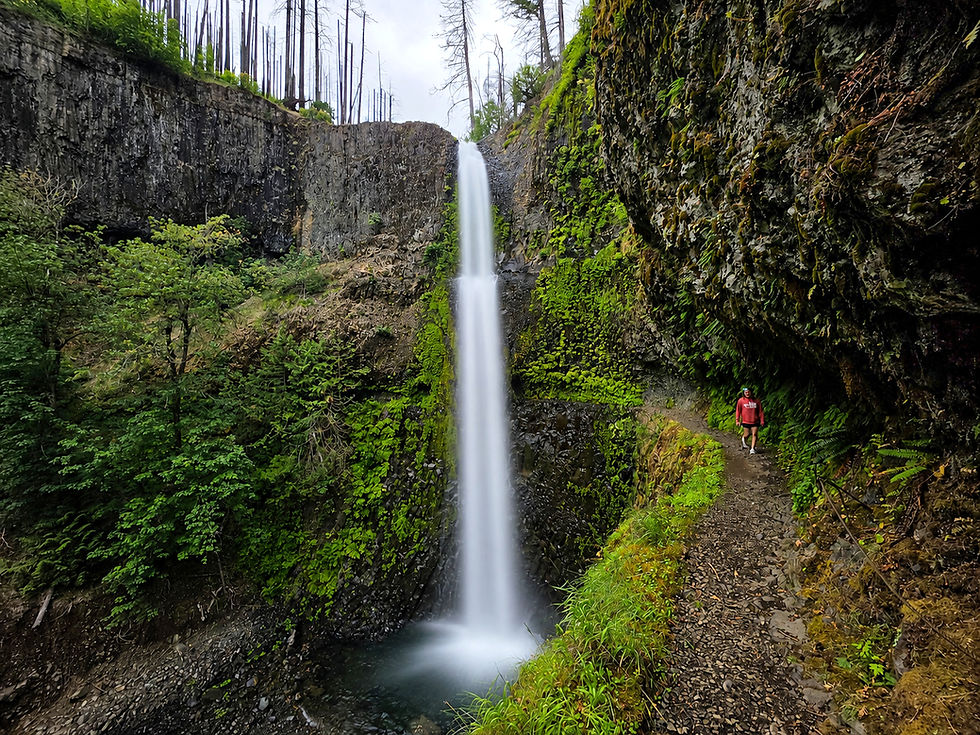
Plunging 213 feet, Elowah Falls bursts through a narrow notch in the basalt before free-falling into an enormous natural amphitheater sculpted over thousands of years. The constant force of McCord Creek has carved a deep plunge pool and hollowed out the surrounding volcanic rock, creating one of the Columbia River Gorge's most impressive waterfall settings. Massive lichen-covered basalt cliffs encircle the falls, while cool mist fills the amphitheater, giving the area an almost prehistoric atmosphere.
Like much of the western Columbia River Gorge, McCord Creek Canyon was dramatically changed by the 2017 Eagle Creek Fire. Although many mature trees were lost, the forest has rebounded remarkably, with young Douglas-firs, maples, and dense undergrowth reclaiming the canyon. Nature continued reshaping the landscape in early 2021, when a massive section of the western basalt wall beside Elowah Falls collapsed into the amphitheater below. The rockfall temporarily buried portions of McCord Creek and permanently altered the appearance of the waterfall's basin—a reminder that the Columbia River Gorge remains a living, ever-changing landscape.

Originally known as McCord Creek Falls, the waterfall was named after early settler John McCord, whose family homesteaded nearby. In 1915, members of the Mazamas successfully petitioned to rename it Elowah Falls, believing the new name better reflected the beauty and Indigenous heritage of the Gorge. Unfortunately, the exact origin and meaning of the word "Elowah" have been lost to history, and no verified Native American translation has ever been documented. Even so, McCord Creek Canyon lies within one of North America's most culturally significant landscapes, where Indigenous peoples have lived, traveled, and fished along the Columbia River for thousands of years.

After enjoying Elowah Falls, hikers should return to the junction and continue toward Upper McCord Creek Falls. The trail climbs steadily through a series of switchbacks before reaching another stretch of outstanding Columbia River viewpoints.

Soon the route traverses a narrow ledge blasted directly into the basalt cliffs high above McCord Creek Canyon. Protected by semi-sturdy railings, this dramatic section offers breathtaking views of the canyon below and a spectacular bird's-eye perspective of Elowah Falls plunging into its basalt amphitheater. Seeing the waterfall from both above and below is one of the highlights of the entire hike.


A short distance later, Upper McCord Creek Falls—sometimes called Upper Elowah Falls—comes into view. Unlike Elowah's powerful single plunge, Upper McCord Creek Falls is an elegant twin waterfall where McCord Creek splits around a moss-covered basalt outcrop before cascading into a lush forested ravine. The setting is quieter and more intimate, making it a beautiful complement to the grandeur of Elowah Falls below.

Beyond the overlook, the trail winds through dense forest before reaching McCord Creek just upstream from the waterfall's brink. Here, hikers can watch the creek gather speed moments before it tumbles over the cliffs into McCord Creek Canyon more than 100 feet below. This marks the end of the maintained trail. When you're ready to head back, simply retrace your steps to the trailhead, enjoying one last series of Columbia River Gorge views before descending to the parking area.




Comments