
Firestone Metro Park's Willow Trail: A Scenic Hike Through Akron's Past

Located in southern Akron, Ohio, Firestone Metro Park is a 258-acre natural retreat where wetlands, wooded trails, and fascinating local history come together. One of the best ways to experience the park is by hiking the 1.6-mile Willow Trail, an easy loop that winds through forests, marshy lowlands, and the floodplain of the Tuscarawas River. Along the way, hikers encounter wooden bridges, an ancient sand hill, and remnants of the region's 19th-century canal system. While the scenery alone makes this one of the more enjoyable hikes in Summit County, the history hidden throughout the landscape makes it especially interesting.

Trail Info
Length 1.5 miles
Elevation gain 20 feet
Route Loop
Permit required No
Dogs allowed On leash
Trailhead elevation 985'
Water fountain at the trailhead
Don't miss sunset at Big Turtle Pond
Hiking the Willow Trail
The hike begins at the Tuscarawas Meadows Area, located at 2620 Harrington Road, where visitors will find a parking lot, restrooms, picnic facilities, a massive open field and access to the Willow Trail.

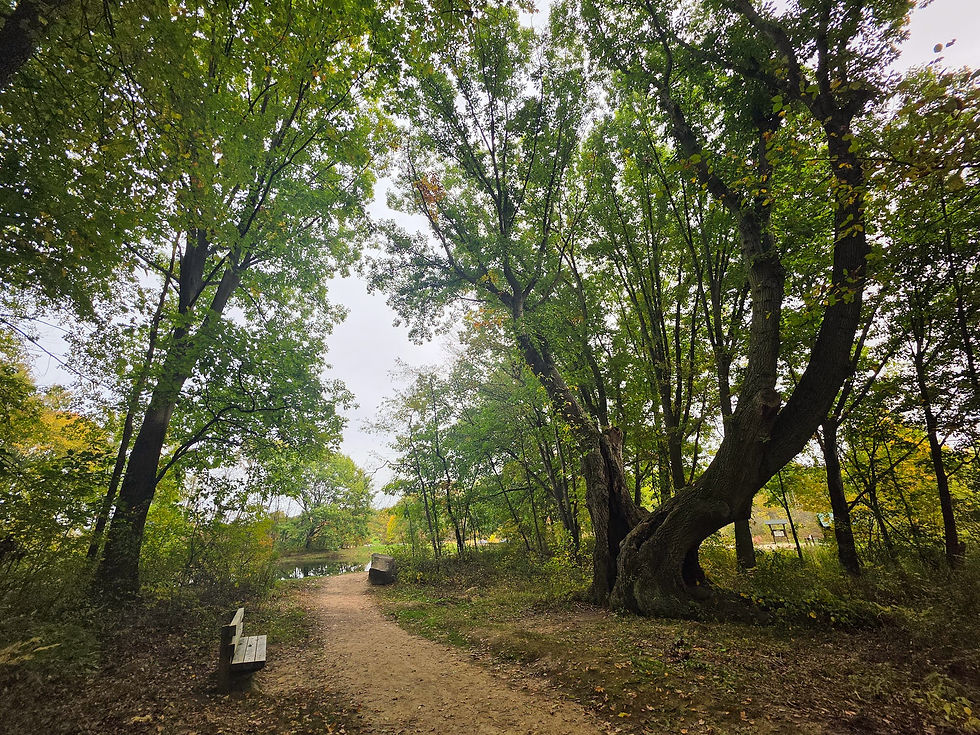
Leaving the trailhead, the path enters a landscape of mature trees and low-lying wetlands, offering an immediate escape from the surrounding neighborhoods of southern Akron. Unlike some of the more challenging hikes in Summit Metro Parks, Willow Trail features relatively flat terrain with few significant changes in elevation. Its gentle grades and changing scenery make it a good choice for families, casual hikers, and anyone interested in exploring the park's natural habitats.

As the trail winds through the forest, it becomes apparent just how much water has influenced the surrounding landscape. The Willow Trail takes its name from the willow trees commonly associated with the moist soils and riverbanks found throughout this part of the park. These trees thrive in floodplain environments, where their flexible branches and narrow leaves are a familiar sight along streams and ponds.

One of the most enjoyable features of Willow Trail is its series of three wooden bridges, which carry hikers across wet areas and provide opportunities to observe the surrounding marsh habitat. During spring and early summer, these areas come alive with birdsong, particularly from red-winged blackbirds perched among the cattails. Firestone Metro Park is considered one of the better birdwatching destinations in the Akron area, with more than 175 bird species recorded within its boundaries. Great blue herons, wood ducks, warblers, and numerous other species frequent the park's wetlands and woodlands, making the bridges particularly good places to stop and observe wildlife.

Although Firestone Metro Park feels like a natural wilderness today, much of its landscape has been shaped by human activity. The park was established in 1941 when the Firestone Tire & Rubber Company donated 89 acres to the Akron Metropolitan Park District.
Founded in 1900 by industrialist Harvey S. Firestone, the company played a major role in transforming Akron into the Rubber Capital of the World. Harvey Firestone died in 1938, just three years before the land donation, but the park's name continues to honor the company's important place in Akron's industrial history. Additional land acquisitions eventually expanded the park to its present size of 258 acres.

Before becoming a public park, portions of the property were used for agriculture, with farms and pastures occupying areas that have since returned to forest and meadow. Historical photographs from the late 1940s show the Farriss family farm on land that is now part of Firestone Metro Park. Dairy cows once grazed nearby hillsides, and the landscape would have appeared considerably more open than it does today. As you walk beneath the trees, it's interesting to consider that some of these wooded areas were once working farmland, shaped by generations of families who lived and worked along the Tuscarawas River.

Another historically significant feature encountered along Willow Trail is the Tuscarawas Race, a man-made waterway excavated during the mid-1800s. The channel was constructed to divert water from the Tuscarawas River toward East Reservoir in the Portage Lakes, helping supply the region's expanding canal system. During the 19th century, the Ohio & Erie Canal played an essential role in the development of Akron and surrounding communities, allowing agricultural products, coal, and manufactured goods to move between Lake Erie and the Ohio River. Coal was also transported along a railroad bed beside the Tuscarawas Race, adding another layer of industrial history to this otherwise peaceful landscape. Today, the channel resembles a natural stream, making it easy to overlook the fact that it was engineered more than 150 years ago.
The nearby Tuscarawas River has its own fascinating history. Long before Akron became an industrial center, the river formed part of an important transportation network used by Indigenous peoples traveling through northeastern Ohio. The historic Portage Path connected the Tuscarawas and Cuyahoga river systems, allowing travelers to move between the Ohio River and Great Lakes watersheds. Although the original portage route was located elsewhere in the Akron area, its historical significance illustrates how important these waterways were long before European settlement.

Interestingly, portions of the Tuscarawas River in this area were once considerably wider than they are today, with historical accounts describing sections that stretched hundreds of feet across.

Much of the wetland scenery along Willow Trail also has an unexpected connection to Akron's industrial past. In 1956, a dam was constructed to create a reservoir for industrial water needs, altering water conditions in the surrounding landscape. The park's low-lying terrain, river, and extensive marshes now provide valuable habitat for fish, frogs, turtles, crayfish, and countless birds. These wetlands are among Firestone Metro Park's defining features and demonstrate how a landscape shaped by human activity can also become an important natural refuge.

Another highlight of the hike is Big Turtle Pond, a popular fishing destination with an interesting history of its own. Unlike a naturally formed pond, Big Turtle Pond was excavated in the early 1940s by workers with the Civilian Conservation Corps, who performed much of the labor by hand before heavy machinery was brought in to finish the project. The pond eventually became a popular gathering place for local families and young anglers, hosting fishing derbies that continue to be part of the park's traditions.

For hikers interested in extending their outing, the Willow Trail connects with the 1.1-mile Redwing Trail, another easy loop that explores the park's wetland habitats. The Redwing Trail features a wooden boardwalk crossing a marshy area and offers additional views of the Tuscarawas River. Its surroundings and excellent birdwatching opportunities make it a worthwhile addition for anyone hoping to spend more time exploring Firestone Metro Park.

As the Willow Trail winds back toward the Tuscarawas Meadows trailhead, the landscape transitions between wooded areas and open wetland scenery, providing a fitting conclusion to an enjoyable hike.

While the trail lacks the dramatic waterfalls and towering rock formations found in some of Summit County's better-known parks, its combination of wildlife, ancient geology, and industrial history makes it an interesting park in its own right. From a 19th-century waterway and a Civilian Conservation Corps excavation to the legacy of one of Akron's most influential companies, the Willow Trail offers much more than its modest 1.6-mile distance might suggest.



Comments