
A Walk in the Woods: Hiking the Black Bear Trail in Liberty Park

Located in Twinsburg, Ohio, the Black Bear Trail at Liberty Park offers a scenic 2.2-mile loop through one of the largest protected natural areas in Summit County. While Liberty Park is best known for its popular Ledges Trail and Glacier Cave, the Black Bear Trail offers a quieter, less-traveled hiking experience with interesting local history and an intriguing connection to the black bears that inspired its name. For hikers looking for scenic trails in Twinsburg or exploring the best hikes in Northeast Ohio, Black Bear Trail is a hidden gem worth discovering.

Trail Info
Length 2.2 miles
Elevation gain 165 feet
Route Loop
Permit required No
Dogs allowed On leash
Trailhead elevation 1,112'
Water fountain near the Nature Center
Don't miss a visit to the Nature Center before or after the hike
Hiking the Black Bear Trail
The hike begins at the Liberty Park Nature Center, located at 9999 Liberty Road in Twinsburg. A large parking area provides access to the trailhead, restrooms, and the nature center.

Before setting out, visitors can explore exhibits highlighting the park's wildlife, geology, and cultural history. Just outside the building stands a life-size black bear statue, an appropriate introduction to a trail whose name reflects one of the park's more surprising wildlife discoveries.

Today, Liberty Park encompasses approximately 3,000 acres, making it the largest natural area managed by Summit Metro Parks. However, the landscape hikers encounter today looks considerably different from what existed here during the 19th century. Following the settlement of Twinsburg, large portions of the surrounding forest were cleared for agriculture, timber harvesting, and other commercial activities. Early farming families transformed the land into cultivated fields and pastures, although some sugar maple trees were deliberately preserved for maple syrup and sugar production. Over time, as agricultural activity declined, abandoned fields gradually returned to forest, creating much of the wooded landscape that visitors enjoy today.
Interestingly, the land that eventually became Liberty Park was once considered for private development. Recognizing the property's ecological importance and the need to preserve open space, Twinsburg officials began negotiating its purchase during the late 20th century. In 2001, Twinsburg residents approved a bond measure to purchase the Twinsburg Ledges Area, helping protect the landscape from development. Subsequent land acquisitions and conservation partnerships helped expand the protected landscape, preserving thousands of acres of forests, wetlands, streams, and sandstone formations for future generations.

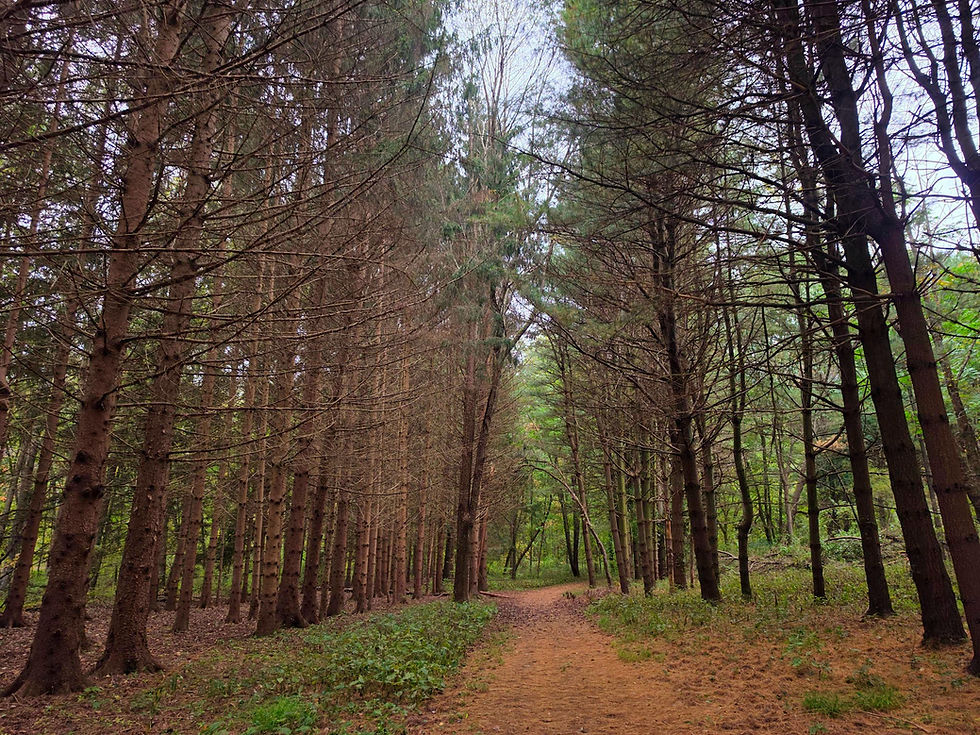
As Black Bear Trail ventures deeper into the forest, the surrounding landscape offers little indication of its agricultural past. Towering hardwoods, fallen trees, and a thick understory create an atmosphere that feels surprisingly remote despite the park's proximity to suburban neighborhoods. Along the western portion of the loop, hikers may notice large depressions in the forest floor where enormous trees have toppled over, pulling their root systems from the ground. These formations, known as pit-and-mound topography, develop when uprooted trees leave behind depressions and raised mounds of displaced soil. Some can remain visible for generations, providing an interesting glimpse into the natural processes that continually reshape the forest.

Continuing along the eastern portion of the loop, the scenery changes as the trail approaches Liberty Park's sandstone ledges. These formations belong to the Sharon Conglomerate, a rock unit deposited approximately 320 million years ago by ancient river systems. Over immense stretches of geological time, erosion and weathering exposed the sandstone, creating the rugged outcroppings, crevices, and boulders visible throughout the park today. Mosses, lichens, and ferns thrive in the cool, shaded environment surrounding the ledges, forming a delicate covering of vegetation that park officials encourage visitors to protect by remaining on established trails.

While the Black Bear never reaches the ledges, hikers interested in exploring the impressive rock formations, Liberty Park's nearby Ledges Trail offers an excellent opportunity. The 1.1-mile loop passes through a remarkable collection of sandstone outcroppings, including Glacier Cave, a narrow passageway between towering rock walls that ranks among the park's most unusual geological features. The trail also winds through a scenic wetland and crosses a lengthy wooden boardwalk before returning to the trailhead.

Perhaps the most intriguing aspect of Black Bear Trail is the story behind its name. Although black bears were once widespread throughout Ohio, hunting and widespread habitat destruction eliminated the state's original resident population by the late 1800s. As forests gradually recovered, black bears began returning to Ohio, primarily from neighboring states. Liberty Park has played a small but fascinating role in that recovery. Summit Metro Parks biologists discovered evidence that at least one black bear had hibernated within the park, an extraordinary finding considering its location in suburban Summit County. While black bear sightings remain uncommon, the discovery demonstrates how important large, connected natural areas can be for wildlife.

The presence of black bears is only one example of Liberty Park's ecological importance. Its forests, wetlands, and waterways provide habitat for bobcats, river otters, salamanders, bald eagles, and numerous other species. In 2006, Audubon Ohio designated Liberty Park an Important Bird Area, recognizing its value to native and migratory bird populations. The park's conservation significance extends well beyond the boundaries of Black Bear Trail, with ongoing habitat restoration projects helping protect the region's natural biodiversity.

Eventually, Black Bear Trail winds back toward the nature center, completing its 2.2-mile loop through one of Twinsburg's most impressive natural landscapes. Although it lacks the dramatic passages and Glacier Cave found along the nearby Ledges Trail, Black Bear Trail offers something equally rewarding: a peaceful forest hike through a landscape shaped by centuries of human activity, millions of years of geological change, and the unexpected return of one of Ohio's most iconic wild animals.


Comments